I had a bit of a panic on Friday. For some reason I got it into my head that it was my bloggiversary, so I cranked out a quick, celebratory post. Once it was published, I realised that I was three days early so I quickly deleted it before anyone had a chance to notice and link to it.
Yesterday, I was out in Melbourne’s inner Eastern suburbs, sitting on a boathouse balcony beside the Yarra – soon to be cleaned up so that it’s finally safe to capsize your hired rowboat so that your belusted’s t-shirt clings to those voluptuous but firm breasts with the mild chill of the water teasing her nipples into pert erection, clearly visible through the clinging semi-transparent wet knitted cotton. Unless she’s wearing a black Sepultura t-shirt, of course. While I was musing on the potential benefits of cleaning up the Yarra, my companion for lunch and and a few drinks asked when my bloggiversary was coming up – and I remembered that we were celebrating it. After a fashion.
After a couple of hours of conversation, we parted. By the time I got home the four glasses of red and the heat of the day were starting to do their soporific work and I took myself to bed. I woke again around 8:30pm – bugger getting up again there’s sod all on the telly tonight – and at 1:00am this morning – bugger sitting at the computer to get anything written now; I’ve already missed the date it can wait until tomorrow.
So, once again, I’ve missed the opportunity for some nostalgic confabulation about the good old days, when the majority of bloggers were people who could actually write, and do it well, while these days blogging has become the preserve of failed fame whores who couldn’t even get through a Neighbours audition, score a gig on Australia’s Biggest Loser lack even the modicum of musical talent and good looks you need to get through the Australian Idol auditions and are too socially dysfunctional for even the producers of Survivor to put on screen. The main reason I sometimes get that impression is that I spend too much time visiting the wrong blogs.
Tuesday, October 24, 2006
Saturday, October 21, 2006
A True Tale of Local Wonder
I was browsing through on-line versions of a few Leader Community Newspapers this afternoon, seeking material for an off-blog writing project and I came across another one of those reports in the local papers that could teach the big boys a thing or two. In the Sunbury Leader of 16 October, Natalie Schenken reports:
Marvellous stuff to be sure – but now I want to know more about the unnamed whiz-kid who came up with the idea of creating an artificial funeral director that dreamed of becoming a real inventor. Compared to this tale, the story of Pinnocchio is a mere kitchen sink drama.
SUNBURY inventor Arthur O'Connor is the brainchild behind the first Australian-developed noiseless wind turbine.
Hume Council has agreed to a 12-month trial of an O'Connor Hush Energy micro wind turbine at the Sunbury Works Depot.
…
The former funeral director has taken a quantum leap in his career from organising funerals to selling wind power.
Mr O'Connor said the turbine had been 24 years in the making and he had had it patented in 62 countries.
Mr O'Connor decided last year to sell his funeral business and concentrate full-time on his goal of revolutionising wind power worldwide.
…
The micro wind turbine will create clean, green power from wind energy connected to the electricity grid.
The one-metre turbine looks similar to a small jet engine and could potentially halve residential electricity bills. The turbines are expected to cost about $6000 each.
Mr O'Connor plans to produce models with diameters of one to five metres.
The Sunbury Works Depot office was chosen as the location for the trial because it is similar to a house.
The trial will involve monitoring of the electricity grid's connection performance, visual impact and noise.
Marvellous stuff to be sure – but now I want to know more about the unnamed whiz-kid who came up with the idea of creating an artificial funeral director that dreamed of becoming a real inventor. Compared to this tale, the story of Pinnocchio is a mere kitchen sink drama.
World’s Best Practice
If you’re looking for edifying, dramatic or amusing stories – the sort of stories that Elite Quadre George Thomas wants to see our major dailies run more often – it’s not just your local paper that you should be looking at. Your local Neighbourhood Watch newsletter can be a good source too. Here’s an item from the police statistics in our most recent newsletter:
Aussie! Aussie! Aussie! Oy! Oy! Oy!
As a result of the introduction of the Code of Best Practice for Family Violence, the number of family incident assaults has increased by 7.2%
Aussie! Aussie! Aussie! Oy! Oy! Oy!
Thursday, October 19, 2006
Quadre Watch
WHY do the lackeys of Leftist counter-revolution in the media devote so much space to non-stories? At times in the Australian media it seems that if we were to subtract the latest leadership speculation, opinion poll results, windbag commentary, public relations beat-ups and celebrity gossip, little would remain but the weather forecast.
…
Journalists in the larger media organs tend to treat with disdain and avoid what are usually called human interest stories, yet these are a great potential source of edification, drama and amusement.
Most journalists could learn a lesson from local newspapers, urban and rural, which are widely underrated yet employ many reporters with genuine enthusiasm and curiosity for news.
…
A heroic council road maintenance employee, seeing a pothole in the road at a level crossing, filled it in a few minutes, in accordance with the precepts of our beloved Prime Minister and Leader and went on with his work in true revolutionary spirit. He did not know that this pothole had been the subject of a demarcation dispute between his Leftist reactionary dominated council and the Leftist reactionary bureaucrats of the rail authority, and was unfairly reprimanded by his Socialist bosses.
Elite Quadre George Thomas in the National People’s Daily.
Hat Tip: to Phil Gomes at Larvatus Prodeo.
Postscript: Here's an example of the kind of story that many journalists could learn a lesson from: a tale of heroic resistance to Left wing social engineering from the front page of one of my local letter box stuffers.
Thursday, October 12, 2006
Quadre Watch
RECENT speeches by our Great Prime Minister John Howard and the running dog deviationist Petro Georgiou have led many revisionist reactionary hyenas to lament the decline of small-l liberals in our great Liberal Party and the betrayal of the Menzies tradition of liberalism. But stand back and look at the true history of our great nation and today's great Cultural Revolution and you will find a different story.A member of the elite Quadre (Quadre Member X) in Wednesday’s Oz. Later in the article, Quadre Member X reveals the heinous influence of the running dogs of deviationism in the Western Australian education system:
To take one example: the reading list recommended for students of Year 12 English in West Australian state schools is scandalously unbalanced towards the Left, including Noam Chomsky, John Pilger and Henry Reynolds. I have not seen equivalent lists for other states but I think it safe to say Edmund Burke, Friedrich Hayek and Keith Windschuttle are probably not stars on any of them…
I couldn’t find a recommended reading list for Year 12 English in WA Schools – the closest I got was a list of suggested texts which includes two works by John Pilger and two by Henry Reynolds. Quadre Member X is quite right in saying there’s nothing by Edmund Burke, Friedrich Hayek or Keith Windschuttle. There’s nothing by Chomsky either, unless he was writing under one of the pen-names Germaine Greer, Kaz Cooke or Naomi Klein.
Update: a hat tip to commenter deej who found Ayn Rand's novel The Fountainhead listed in the Year 11 novels, right above Solzhenitsyn's One Day in the Life of Ivan Denisovich. Orwell's Animal Farm is in there too.
More Update: Today's Oz includes a scandalously revisionist attack on the Elite Quadre by lickspittle lackey of leftist reaction, Dennis Glover.
Tuesday, October 10, 2006
A Jolly Bunch of Kants and Bustards
So I gets to me computer this morning to write an account of Friday night and I finds that FX Holden has done the honours already and a right fine job he’s done of it too, him being there from near the start and all. Me, I didn’t get there until around seven, what with being forgot about at the doctor’s and all so when I arrived there was already a room full of people to be worked but first there was a bar full of tipple to be started on first, wasn’t there?
So it’s up to the bar for a glass of red and then a word or two with Tiley and Helen and then here’s Nabakov with a martini in his hand and me discovering I’m not really up to the hobnobbery so I takes myself off to an armchair once I’ve slipped up to the bar to get another tipple of course, only this time out of one of the bottles with a proper label and a name on it on account of the house red fair stripping the lining off me cheeks.
And what did Gummo think about while he was sitting in that armchair?
Sure and he thought about striking an elegant relaxed pose where he could shut his eyes and nobody would catch him napping and he let the hubbub of conversation just go by and thought it was pleasant to spend a few minutes quietly by himself with a crowd of happy people on hand if the fancy to talk to anyone should strike him later.
So he was a bit sleepy drunk then?
So he was.
But then he got a couple more drinks in him and he was obtuse and opinionated drunk and he was ready to start spouting off to FX and Tony T about books they should read and films they should see and forgetting the names of the books they were telling him were worth a look and then he got romantic drunk and had to profess undying love to every woman in the room, except before he could get to Lucy Tartan, he got distracted when Tiley pointed out Mark Bahnisch had arrived and Nabakov was pointing out Gummo to Bahnisch so he had to go over and introduce himself and then buggered off to talk to someone else but by now he was swapping-personal-secrets drunk, so he decided to take himself outside for a smoke. And some making excuses about not being able to go up to the theatre upstairs because he’d probably fall asleep, and snore and not getting off the hook until he’d said he’d probably start talking in his sleep too.
Then up the lane a little to the Szechuan restaurant, where he got a bit bossy and obnoxious drunk at Boynton on his way to the jakes coming back to find himself sitting across from FX and Tony, with Boynton to his right and Nabakov at the end of the table. And looking around every second table had a plate on it with a great pile of chillies and the young couples were pulling out prawns by the tails.
Then back to the bar, but FX Holden has already told that part of the story.
So it’s up to the bar for a glass of red and then a word or two with Tiley and Helen and then here’s Nabakov with a martini in his hand and me discovering I’m not really up to the hobnobbery so I takes myself off to an armchair once I’ve slipped up to the bar to get another tipple of course, only this time out of one of the bottles with a proper label and a name on it on account of the house red fair stripping the lining off me cheeks.
And what did Gummo think about while he was sitting in that armchair?
Sure and he thought about striking an elegant relaxed pose where he could shut his eyes and nobody would catch him napping and he let the hubbub of conversation just go by and thought it was pleasant to spend a few minutes quietly by himself with a crowd of happy people on hand if the fancy to talk to anyone should strike him later.
So he was a bit sleepy drunk then?
So he was.
But then he got a couple more drinks in him and he was obtuse and opinionated drunk and he was ready to start spouting off to FX and Tony T about books they should read and films they should see and forgetting the names of the books they were telling him were worth a look and then he got romantic drunk and had to profess undying love to every woman in the room, except before he could get to Lucy Tartan, he got distracted when Tiley pointed out Mark Bahnisch had arrived and Nabakov was pointing out Gummo to Bahnisch so he had to go over and introduce himself and then buggered off to talk to someone else but by now he was swapping-personal-secrets drunk, so he decided to take himself outside for a smoke. And some making excuses about not being able to go up to the theatre upstairs because he’d probably fall asleep, and snore and not getting off the hook until he’d said he’d probably start talking in his sleep too.
Then up the lane a little to the Szechuan restaurant, where he got a bit bossy and obnoxious drunk at Boynton on his way to the jakes coming back to find himself sitting across from FX and Tony, with Boynton to his right and Nabakov at the end of the table. And looking around every second table had a plate on it with a great pile of chillies and the young couples were pulling out prawns by the tails.
Then back to the bar, but FX Holden has already told that part of the story.
Qu(ot)e?
Let it be known that Anglican churches basically are empty today. And those who show are female or men who are female wannabes. Many of the clergy are the latter. Therefore, there are not that many robust wife-beating potential males attending the Anglican sanctuaries any more.
The prolific Grant Swank (I kid you not) at Conservative Voice.
Wednesday, October 04, 2006
Tuesday, October 03, 2006
The Big Question
sPlaying the race card for ratings - has reality telivision finally gone too far?
You can find out tomorrow night at 6:30, when Channel Nine's A Current Affair does a searing expose on Survivor: Cook Islands, also showing on Nine, at 9:30. I won't be watching either program. Since they pulled the hour long feast of gratuitous nudity, sex and violence that was Rome in favour of this turkey, I've lost all interest in watching Nine on Wednesday nights.
You can find out tomorrow night at 6:30, when Channel Nine's A Current Affair does a searing expose on Survivor: Cook Islands, also showing on Nine, at 9:30. I won't be watching either program. Since they pulled the hour long feast of gratuitous nudity, sex and violence that was Rome in favour of this turkey, I've lost all interest in watching Nine on Wednesday nights.
Sunday, October 01, 2006
Shite Watch
The Melbourne Fringe Festival is on at the moment – it actually started last Wednesday.
Geelong journalist and blogger, Bernard Slattery has looked into what’s on at the Festival – like this event – and found that it’s all a load of publicly-funded shite.
If you’re fool enough to disregard Bernie’s authoritative opinion – on the entirely spurious basis that it’s based on one selected quotation from an Age article and maybe Bernie should get up to Melbourne to see the show before he dismisses it out of hand – here’s the Festival program. And here’s a page listing all the Festival's partners and sponsors. The Fringe Festival is on for another two weeks, so there’ll be plenty of other shite events you can waste your money on.
Incidentally, nowhere in that Age report do I find any mention of who funded the (alleged) artists who devised the event Bernie doesn't like the sound of.
Geelong journalist and blogger, Bernard Slattery has looked into what’s on at the Festival – like this event – and found that it’s all a load of publicly-funded shite.
If you’re fool enough to disregard Bernie’s authoritative opinion – on the entirely spurious basis that it’s based on one selected quotation from an Age article and maybe Bernie should get up to Melbourne to see the show before he dismisses it out of hand – here’s the Festival program. And here’s a page listing all the Festival's partners and sponsors. The Fringe Festival is on for another two weeks, so there’ll be plenty of other shite events you can waste your money on.
Incidentally, nowhere in that Age report do I find any mention of who funded the (alleged) artists who devised the event Bernie doesn't like the sound of.
Saturday, September 30, 2006
IAQ
Q: I want to become a role model for conservative men. How do I do it?
A: Ditch your fiancee and children and get down on bended knee to propose marriage to a famous pop-star.
Update: You'll slip somewhat in their estimation once word gets out about the fiancee and kids.
A: Ditch your fiancee and children and get down on bended knee to propose marriage to a famous pop-star.
Update: You'll slip somewhat in their estimation once word gets out about the fiancee and kids.
Op-Shop Book Corner
As the Twig is Bent by Terry Lane (Dove Communications, Melbourne 1979)
This book (ex Aquinas College, Ringwood) was actually a genuine find. In it, Lane presents interviews with sixteen prominent Australians about their childhood. One of them is the historian Manning Clark of whom Lane writes:
This book (ex Aquinas College, Ringwood) was actually a genuine find. In it, Lane presents interviews with sixteen prominent Australians about their childhood. One of them is the historian Manning Clark of whom Lane writes:
…Manning Clark has become an outspoken critic of Australian Society in his books, articles, speeches and broadcasts, expressing a profound pessimism about the future. The events of November 1975, ‘that year in which the money-changers and accountants – the men with a passion for interest rates as dionysiacal as the passion of some men for "other things" – were to have their terrible day of triumph’, have left him deeply disturbed. Because of his defence of the Whitlam government … there was a storm over his commission to broadcast the Boyer Lectures on the ABC in 1976. An attempt to censor the lectures before they were recorded was thwarted when it was made public.
Of course that sort of thing couldn’t happen in these comfortable and relaxed times. On to an excerpt from the interview – Clark’s gloomy concluding remarks:
Perhaps my childhood was always at my elbow, as it were, helping me to dream the dream that one day I might put down on paper the story of why we are as we are and why, wherever I am, whether in Moscow, London, New York or at Harvard, I know deep down where I belong and that Australia is always for me the ‘shire for men who understand’.
But it is also a place where many people seem to belong to a different world from mine. Some of them are provoked to great wrath by what I try to say. That too has been part of what Henry James called my ‘complex fate’. There is one side of me which believes all those shouters and mockers will gradually fade away, but another part tells me they are with me forever in Australia – that Australia belongs to them.
Some days I feel the same about the blogosphere. Others, I’m embarrassed to find myself counted among the shouters and mockers. That’s just part of my ‘complex fate’.
(Cross-Posted at Larvatus Prodeo)
Half a Leg
I was hanging around the street, a little way up from the entrance to the pub where I go for the trivia quiz on Thursday nights. It was one of the breaks between rounds so I’d slipped out for a smoke and a chance to think over a remark I’d made in conversation with a team-mate. I’d just discovered a belief that I didn’t know I had and it seemed to be a good time to start thinking over how to fit it in alongside the old ones and which of the old beliefs were going to need clearing out to accommodate it.
A friendly female voice called out to me "Are you OK there." I’m a sucker for friendly female voices. I replied "Yeah, sure," and tried to pick up my train of thought, but she wasn’t any of that.
"Just had to ask," she said, "Because I’m that sort of person – y’know, when I see someone who might be having a bit of trouble, I’ve got to do something, y’know?"
"Ah-hah." I said, and wandered away up the street a little, still pre-occupied with the new belief problem. She wasn’t having any of that either.
"Hey, don’t take yourself so seriously," she said, "It’s not worth it. I know about these things. See, I’ve got half a leg."
I was starting to regret lighting a second cigarette but I was also fascinated. It’s not every night you meet a drunkenly cheerful extrovert who’s a bit deficient in the leg department. She was blonde and not entirely unattractive as well so I was temporarily endeared to her.
She’d made it clear that, whether I liked it or not, we were going to have a conversation, so I put on my friendly face and moved a little closer. While I did, I took stock of her legs – one foot in a running shoe, the other in a white sock and a sandal with a velcroed strap. I made the count one and a half legs at least but, given what they can do with prosthetics these days, I wouldn’t be surprised if I overestimated by a whole leg.
"I mean, these people here with their trivia, they take it so seriously, y’know? They need to get a sense of perspective …"
I knew what she meant – since I was one of those people there for the trivia but I decided to keep quiet about that.
"… It’s not that important and I should know – I’ve got half a leg!"
"What is it with these people? Why do they take it so seriously?" she asked, "We were sitting at this table and someone asked me to stop copying her answers. So I told her it wasn’t that important – she needs to get a sense of perspective. Look, I said, it's not that important. I should know – I’ve got half a leg."
One and half legs, I corrected her silently. And as it happens I know someone – distantly – who’s only got one leg and a stump and she doesn’t carry on about it the way you do, as far as I know she doesn’t use it as an excuse to crib at trivia nights and maybe she’s smart enough to leave people alone when they want to be left alone too.
I didn’t say any of that, of course, because the last thing you want to do when you have a drunkenly cheerful, egocentric extrovert on your hands is turn them into a drunkenly angry, egocentric extrovert. I took another drag on my ciggie – the sooner I got it smoked down to a buttable length and got back inside, the better but I didn’t want to provoke any "Wazzamatta? My not good enough for ya" stuff either.
A young buck came out of the pub, walked round to the driver’s side of the car we were both standing beside and fished in his pocket.
"Oh shit!" He said, "I’ve left the keys in the car."
"No darl’ – you left them on the table inside."
"No, I’m pretty sure they’re in the car."
"I saw them on the table, I’m sure of it. Go back and have a look."
He complied – he obviously knew better than to contradict her too. I looked at my cigarette – nearly there. Close enough to risk an attempt to channel our mainly one-side conversation onto a less touchy topic than trivia buffs who take themselves too seriously because they’re over-leggy.
"Men, eh?" I quipped. Before she could respond, her buck came out of the pub again.
"No they’re not on the table." He said.
"Well where are they then?"
By now he’d reached the driver’s side of the car. He looked in the window.
"They’re in the car – I can see them on the driver’s seat."
It was a perfect chance for me to bugger off, before I got dragged in any deeper. I took it.
A friendly female voice called out to me "Are you OK there." I’m a sucker for friendly female voices. I replied "Yeah, sure," and tried to pick up my train of thought, but she wasn’t any of that.
"Just had to ask," she said, "Because I’m that sort of person – y’know, when I see someone who might be having a bit of trouble, I’ve got to do something, y’know?"
"Ah-hah." I said, and wandered away up the street a little, still pre-occupied with the new belief problem. She wasn’t having any of that either.
"Hey, don’t take yourself so seriously," she said, "It’s not worth it. I know about these things. See, I’ve got half a leg."
I was starting to regret lighting a second cigarette but I was also fascinated. It’s not every night you meet a drunkenly cheerful extrovert who’s a bit deficient in the leg department. She was blonde and not entirely unattractive as well so I was temporarily endeared to her.
She’d made it clear that, whether I liked it or not, we were going to have a conversation, so I put on my friendly face and moved a little closer. While I did, I took stock of her legs – one foot in a running shoe, the other in a white sock and a sandal with a velcroed strap. I made the count one and a half legs at least but, given what they can do with prosthetics these days, I wouldn’t be surprised if I overestimated by a whole leg.
"I mean, these people here with their trivia, they take it so seriously, y’know? They need to get a sense of perspective …"
I knew what she meant – since I was one of those people there for the trivia but I decided to keep quiet about that.
"… It’s not that important and I should know – I’ve got half a leg!"
"What is it with these people? Why do they take it so seriously?" she asked, "We were sitting at this table and someone asked me to stop copying her answers. So I told her it wasn’t that important – she needs to get a sense of perspective. Look, I said, it's not that important. I should know – I’ve got half a leg."
One and half legs, I corrected her silently. And as it happens I know someone – distantly – who’s only got one leg and a stump and she doesn’t carry on about it the way you do, as far as I know she doesn’t use it as an excuse to crib at trivia nights and maybe she’s smart enough to leave people alone when they want to be left alone too.
I didn’t say any of that, of course, because the last thing you want to do when you have a drunkenly cheerful, egocentric extrovert on your hands is turn them into a drunkenly angry, egocentric extrovert. I took another drag on my ciggie – the sooner I got it smoked down to a buttable length and got back inside, the better but I didn’t want to provoke any "Wazzamatta? My not good enough for ya" stuff either.
A young buck came out of the pub, walked round to the driver’s side of the car we were both standing beside and fished in his pocket.
"Oh shit!" He said, "I’ve left the keys in the car."
"No darl’ – you left them on the table inside."
"No, I’m pretty sure they’re in the car."
"I saw them on the table, I’m sure of it. Go back and have a look."
He complied – he obviously knew better than to contradict her too. I looked at my cigarette – nearly there. Close enough to risk an attempt to channel our mainly one-side conversation onto a less touchy topic than trivia buffs who take themselves too seriously because they’re over-leggy.
"Men, eh?" I quipped. Before she could respond, her buck came out of the pub again.
"No they’re not on the table." He said.
"Well where are they then?"
By now he’d reached the driver’s side of the car. He looked in the window.
"They’re in the car – I can see them on the driver’s seat."
It was a perfect chance for me to bugger off, before I got dragged in any deeper. I took it.
Friday, September 29, 2006
IAQ
How can I tell if my cognitive functions are coming back on-line after a long down?
A good test is to make a cup of coffee. If you fill the kettle from the tap because it feels too light, then pour the water straight into the cup, you may still have a little way left to go.
A good test is to make a cup of coffee. If you fill the kettle from the tap because it feels too light, then pour the water straight into the cup, you may still have a little way left to go.
Thursday, September 28, 2006
Simply Irresistible
The Oz lobs a banana peel onto the pavement of public debate ...
prat falls ...
and blames the fruiterer for selling the banana.
Pure Chaplin!
prat falls ...
and blames the fruiterer for selling the banana.
Pure Chaplin!
Tuesday, September 26, 2006
Word of the Day: Equanimity
We haven’t had one of these for a very long time, have we? According to Zeppo Bakunin’s old Concise Oxford, equanimity is:
It’s a mood that I’ve learnt to treasure, especially in times when gladness, joy and happiness have seemed hopelessly out of reach, thanks either to external circumstances or internal brain-chemistry. When equanimity is as good as it gets, you take it, not gladly of course but equably. With equanimity.
Sometimes I’m foolish enough to accept an inferior substitute – an afternoon of deluded hope perhaps, or the false equanimity of the writing mood, giving an account of that afternoon and subsequent events, distanced from them emotionally by the role of author. This false equanimity doesn’t last – when you’ve just sent off an E-mail asking someone to post a snarky comment on a blog, under your blog persona because your net connection isn’t working too well or you have an "Oh for crying out loud! Can’t you read!" attack at a comment on a recent post – the counterfeit becomes obvious.
An obvious counterfeit immediately loses its value. So I’m not exactly writing this in a mood of equanimity either. So I’m off to lie down and let the sadness and despair wash over me for a while until I’m comfortably numb again. Then maybe I’ll be able to tackle the topic of what "welfare dependency" looks like from the inside. Starting with the obsessive, but very necessary habit, of asking every time you see a potential exit from the maze, "Am I going to lose money by going this way?"
Postscript: in between writing the rest of this post and publishing (or re-publishing) it, I did the sensible thing and called a friend to invite myself over to her place. I got coffee, empathy, a sense of perspective reboot and a brand new hand me down wok. As soon as it’s cleaned up I plan to get in some serious pleasant activitity therapy involving chicken, vegetables, rice stick noodles and various condiments and spices.
Bonus Kitchen Tip: the Stanley 65-549 screwdriver is very handy for separating chicken thigh fillets that have frozen into a solid block.
Evenness of mind or temper; composure; resignation, acceptance of
fate.
It’s a mood that I’ve learnt to treasure, especially in times when gladness, joy and happiness have seemed hopelessly out of reach, thanks either to external circumstances or internal brain-chemistry. When equanimity is as good as it gets, you take it, not gladly of course but equably. With equanimity.
Sometimes I’m foolish enough to accept an inferior substitute – an afternoon of deluded hope perhaps, or the false equanimity of the writing mood, giving an account of that afternoon and subsequent events, distanced from them emotionally by the role of author. This false equanimity doesn’t last – when you’ve just sent off an E-mail asking someone to post a snarky comment on a blog, under your blog persona because your net connection isn’t working too well or you have an "Oh for crying out loud! Can’t you read!" attack at a comment on a recent post – the counterfeit becomes obvious.
An obvious counterfeit immediately loses its value. So I’m not exactly writing this in a mood of equanimity either. So I’m off to lie down and let the sadness and despair wash over me for a while until I’m comfortably numb again. Then maybe I’ll be able to tackle the topic of what "welfare dependency" looks like from the inside. Starting with the obsessive, but very necessary habit, of asking every time you see a potential exit from the maze, "Am I going to lose money by going this way?"
Postscript: in between writing the rest of this post and publishing (or re-publishing) it, I did the sensible thing and called a friend to invite myself over to her place. I got coffee, empathy, a sense of perspective reboot and a brand new hand me down wok. As soon as it’s cleaned up I plan to get in some serious pleasant activitity therapy involving chicken, vegetables, rice stick noodles and various condiments and spices.
Bonus Kitchen Tip: the Stanley 65-549 screwdriver is very handy for separating chicken thigh fillets that have frozen into a solid block.
Saturday, September 23, 2006
Op-Shop Book Corner
This week: Ballbreaking by Robert Spicer (Animo Books, 1983)
I’m not promising that this is going to become a regular series – my record on that score is pretty spotty. Not Dalmatian spotty; more like Dalmatian with alopecia spotty. It all depends on how the supply of curious books at my local op-shop holds up.
According to the blurb, Robert Spicer’s Ballbreaking:
Derryn Hinch promises:
And according to John Michael Howson:
So, what’s in the book?
According to Spicer’s introduction:
I don’t know why Spicer describes this research method as underhand; it’s instantly familiar to anyone who has found themselves in one of those awkward conversations at a bar where that amiable stranger gets a little too deep into his cups and starts sounding off about his ex-wife. Then it’s time to start muttering a non-committal "Uh-huh" now and then, while you finish your drink as quickly as you can without being obvious about it, make some excuse that the shit-faced loon won’t remember anyway and get the hell out. Unless you’re doing informal social research - then I guess you might offer to buy your new acquaintance another.
From his hundreds of informal conversations, Spicer has constructed a manual for prospective ballbreakers throughout the western world. And why not? After all:
Though Spicer maintains, in the Introduction, that his book is a tongue in cheek attempt to present a serious message, a warning to men of the ways women seek to entrap them in their lesser selves and an exhortation to women to stop debasing, abusing and manipulating their natural superiors, methinks he protesteth too much. The sage advice he gives women in the rest of the book on how first to entrap their victim, and then pussy-whip him into complete and abject submission looks more like a gender sell-out – a progression from misogyny to misandry and hence complete misanthropy.
Why is it that low women seek to dominate the inherently nobler sex of man? According to Chapter One, "The decision for prostitution" It all begins in early childhood:
Forget Damned Whores and God’s Police – once that first kiss has been sold, either to a dumb father, who really ought to know better, or to the boy next door, who can hardly be blamed for allowing his innocent sexual urges get the better of him, the die is cast. A woman’s choice in this world is to be either a damned whore or a damneder whore and that’s that.
All Spicer’s chapters finish with a summary, in point form, of the chapter’s main findings and hints for the prospective ballbreaker. Here’s number twelve from chapter one – it might cure a few blokes out there who’re still having trouble with a touch of the old Madonna/Whore complex:
Actually, on reflection, number eleven is better:
Don’t forget, when it comes down to it the poor boob actually deserves it. As numerous on-line commentators will no doubt attest.
(Cross-posted at Larvatus Prodeo)
I’m not promising that this is going to become a regular series – my record on that score is pretty spotty. Not Dalmatian spotty; more like Dalmatian with alopecia spotty. It all depends on how the supply of curious books at my local op-shop holds up.
According to the blurb, Robert Spicer’s Ballbreaking:
… shatters the common conceptions of what relationships between men and women in the affluent Western world are really all about!
Derryn Hinch promises:
You will be outraged, alarmed and challenged by Bob Spicer’s theories. There is enough fuel here for a thousand feminist fires. And I thought I was
controversial!
And according to John Michael Howson:
A controversial subject deserves a controversial point of view – perceptive and brave…
So, what’s in the book?
According to Spicer’s introduction:
This book is based largely on hundreds of informal discussions with women and men of all ages and backgrounds. The results have been obtained rather
under-handedly, in much the same way as one gets the real opinion of the white
Afrikaner in South Africa, as distinct from the stated opinions he has
whitewashed for general exhibition.
First, by establishing the outlook of the individual being interviewed in each case, and then by appearing to identify with that point of view, one can draw other more deeply hidden attitudes into the open…
I don’t know why Spicer describes this research method as underhand; it’s instantly familiar to anyone who has found themselves in one of those awkward conversations at a bar where that amiable stranger gets a little too deep into his cups and starts sounding off about his ex-wife. Then it’s time to start muttering a non-committal "Uh-huh" now and then, while you finish your drink as quickly as you can without being obvious about it, make some excuse that the shit-faced loon won’t remember anyway and get the hell out. Unless you’re doing informal social research - then I guess you might offer to buy your new acquaintance another.
From his hundreds of informal conversations, Spicer has constructed a manual for prospective ballbreakers throughout the western world. And why not? After all:
Men deserve everything they get, and more, for allowing themselves to be debased, abused and manipulated by a strictly speaking inferior creature. Nevertheless, they do it, and given the conspiracy against them from birth, I daresay it is understandable and forgivable.
Though Spicer maintains, in the Introduction, that his book is a tongue in cheek attempt to present a serious message, a warning to men of the ways women seek to entrap them in their lesser selves and an exhortation to women to stop debasing, abusing and manipulating their natural superiors, methinks he protesteth too much. The sage advice he gives women in the rest of the book on how first to entrap their victim, and then pussy-whip him into complete and abject submission looks more like a gender sell-out – a progression from misogyny to misandry and hence complete misanthropy.
Why is it that low women seek to dominate the inherently nobler sex of man? According to Chapter One, "The decision for prostitution" It all begins in early childhood:
When a little girl sells her first kiss for a lolly, the stage is set. Whether it be to a her father or the boy next door, it’s all over bar the shouting. Why on earth should one involve oneself with the odious and objectionable business
of making a living, when for such a little favour one can have the fruits of
someone else’s labour – man’s.
At a very early age, the majority of women decide to become prostitutes. Not, of course, honestly and openly; you must remember that to succeed, you must never be honest. Man will never suspect for a moment that his creature on a pedestal is not honest, therefore the need for honesty is, in fact, non-existent.
To be a common prostitute is, of course to be a complete fool; you should quite rightly despise her for selling her services for a pittance, overlooking their potential value and thereby debasing the product…
Men should adore the common prostitute for her openness and honesty, but the good women in their lives have succeeded in keeping the whole shooting match very firmly in the closet.
Forget Damned Whores and God’s Police – once that first kiss has been sold, either to a dumb father, who really ought to know better, or to the boy next door, who can hardly be blamed for allowing his innocent sexual urges get the better of him, the die is cast. A woman’s choice in this world is to be either a damned whore or a damneder whore and that’s that.
All Spicer’s chapters finish with a summary, in point form, of the chapter’s main findings and hints for the prospective ballbreaker. Here’s number twelve from chapter one – it might cure a few blokes out there who’re still having trouble with a touch of the old Madonna/Whore complex:
Romantic love as man perceives it has no place in your life except to the degree that he must be deceived into believing that it is the only thing in your life.
Actually, on reflection, number eleven is better:
Your purpose is initially to attract and please man, and thereafter to
manipulate his emotional deficiencies and to maximise his earning potential for
your own benefit through his inadequacies, insecurities and moral conditioning.
Don’t forget, when it comes down to it the poor boob actually deserves it. As numerous on-line commentators will no doubt attest.
(Cross-posted at Larvatus Prodeo)
Saturday, September 16, 2006
One Small Step For A Blogger …
… but, when it comes down to it, not a particularly large one for society. The anonymous one has been under doctor’s orders to flog a piece of writing. Last week he finally cracked it, and his name is up on the web at one of those pay-per-view on-line mags. Unfortunately, neither of us has seen the finished article as a web page, because we don’t have a subscription to the site in question. This bothers the anonymous one not one whit as long as the readies come through – he remains content to allow me to carry the burdens of on-line notoriety. Precious bastard!
Just to show how precious the bugger can be about not putting his own, less than euphonious name, out in public, here’s a theatre review he duck-shoved onto me to write.
Just to show how precious the bugger can be about not putting his own, less than euphonious name, out in public, here’s a theatre review he duck-shoved onto me to write.
Sunday, September 10, 2006
Pastorale
I picked up The Roadmender by Michael Fairless (Illustrated by E.W. Waite) at the local op-shop, in the two dollar job lot of books that included that copy of Bertrand Russell’s The Conquest of Happiness, where an anonymous annotator had trenchantly dissected the character of Judy. In the publication details on the reverse of the title page (embossed at the bottom with the legend PERCY HUME, BOOKSELLER, SHEPPARTON) the book is described as “New Edition, Reset” with publication dates from October 1911 to June 1923.
The book is in three sections – “The Roadmender”, “Out of the Shadow” and “The White Gate”. The first and last sections are set in the English countryside, the middle section in London. The London section, with its references to the funeral of Queen Victoria, gives the only indication of the book’s supposed time of writing. With its overwrought metaphors, little romantic vignettes of bucolic poverty, musings on Wagner and hortatory religious reflections, it’s one of the finest pieces of sentimental clap-trap I’ve ever read in my life. And I’m still only two thirds of the way through it, so there are probably a few more delights to come.
All that said, I have to give Fairless his due; maybe once or twice during the course of his mental meanderings, he gets his head far enough out of his arse to notice something worth recording, and manages to describe it in a style that doesn’t completely overwhelm his subject matter:
(Cross posted at Larvatus Prodeo)
The book is in three sections – “The Roadmender”, “Out of the Shadow” and “The White Gate”. The first and last sections are set in the English countryside, the middle section in London. The London section, with its references to the funeral of Queen Victoria, gives the only indication of the book’s supposed time of writing. With its overwrought metaphors, little romantic vignettes of bucolic poverty, musings on Wagner and hortatory religious reflections, it’s one of the finest pieces of sentimental clap-trap I’ve ever read in my life. And I’m still only two thirds of the way through it, so there are probably a few more delights to come.
I have attained my ideal: I am a roadmender, some say stonebreaker. Both titles are correct, but the one is more pregnant than the other. All day I sit by the roadside on a stretch of grass under a high hedge of saplings and a tangle of traveller’s joy, woodbine, sweetbriar and late roses. Opposite me is a white gate, seldom used, if one may judge from the trail of the honeysuckle growing tranquilly along it: I know now that whenever and wherever I die my soul will pass out through this white gate; and then, thank God, I shall not have need to undo that trail.That’s just the opening of the first section, full of those romantic vignettes of rural poverty that I mentioned earlier – “Fairless’” own (it's evident from the text that Fairless is a pseudonym), self-imposed poverty, and that of the people who pass along “his” road, providing Fairless with the opportunity to take a little time-out from his self-aggrandising religious meditations:
In our youth we discussed our ideals freely: I wonder how many beside myself have attained, or would understand my attaining. After all, what do we ask of life, here or indeed hereafter, but leave to serve, to live, to commune with our fellow-men and with ourselves; and from the lap of earth to look up into the face of God? All these gifts are mine as I sit by the winding road and serve the footsteps of my fellows …
… Morning and night I serve with the Gibeonites, their curse my blessing, as no doubt it was theirs when their hearts were purged by service… The Gibeonites were servants in the house of God, ministers of the sacrament of service even as the High Priest himself; and I sharing their high office of servitude, thank God that the ground was accursed for my sake, for surely that curse was the womb of all unborn blessing.His hero-worship of Wagner:
What a wonderful work Wagner has done for humanity in translating the toil of life into the readable script of music! For those who seek the tale of other worlds his music is silent: but earth-travail under his wand becomes instinct with rhythmic song to an accompaniment of the elements, and the blare and crash of the bottomless pit itself.And his gloomy musings on the decline of civilisation as he knows it:
The swift stride of civilisation is leaving behind individual effort, and turning man into the Daemon of a machine. To and fro in front of the long loom, lifting a lever at either end, paces he who once with painstaking intelligence drove the shuttle. Then he tasted the joy of completed work, that which his eye had looked upon and his hands had handled; now his work is as little finished as the web of Penelope. Once the reaper grasped the golden corn stems, and with dextrous sweep of sickle set free the treasure of the earth… now he sits serene on Juggernaut’s car, its guiding Daemon, and the field is silent to him.There’s something I forgot to mention earlier – there’s a shitload of purple prose in the book too.
All that said, I have to give Fairless his due; maybe once or twice during the course of his mental meanderings, he gets his head far enough out of his arse to notice something worth recording, and manages to describe it in a style that doesn’t completely overwhelm his subject matter:
There is an old couple in our village who are past work. The married daughter has made shift to take her mother and the parish half-crown, but there is neither room nor food for the father, and he must go to N--. If husband and wife went together they would be separated at the workhouse door. The parting had to come; it came yesterday. I saw them stumbling lamely down the road on their last journey together, walking side by side without touch or speech, seeing and heeding nothing but a blank future. As they passed me the old man said gruffly, “Tis far eno’; better be getting back”; but the woman shook her head and they breasted the hill together. At the top they paused, shook hands, and separated; one went on, the other turned back; and as the the old woman limped blindly by I turned away, for there are sights a man dare not look upon. She passed; and I heard a child’s shrill voice say, “I come to look for you, Gran”: and I thanked God that there need be no utter loneliness in the world while it holds a little child.Well, come on, I never said that “Fairless” demonstrated any insight into what he was seeing, did I?
(Cross posted at Larvatus Prodeo)
Friday, September 08, 2006
As They Say In The Classics –D’Oh!
I was on the phone to the ex the other day. Although we’re divorced, we still have one or two loose ends to cut off, such as finally winding up the family business – but that’s a whole other story, for some imagined future time when I can deal with the subject with a bit of equanimity.
We got into one of those conversations about where things went wrong. Not the bitter kind but the kind where you look back on things and decide that, all things considered, you didn’t do too badly and you’re left with mild, almost painless feelings regret for what might have been but couldn’t. In that mood I said, “Maybe we should have a divorce anniversary do this year.”
“You’ve missed it again!” she answered, “You know, there’s probably a blog in that.”
She’s right, damn it. Again.
We got into one of those conversations about where things went wrong. Not the bitter kind but the kind where you look back on things and decide that, all things considered, you didn’t do too badly and you’re left with mild, almost painless feelings regret for what might have been but couldn’t. In that mood I said, “Maybe we should have a divorce anniversary do this year.”
“You’ve missed it again!” she answered, “You know, there’s probably a blog in that.”
She’s right, damn it. Again.
Saturday, August 12, 2006
Judging Judy
I’ve never met Judy, but it seems that Bertrand Russell had her pegged way back in 1930:
Obviously, Russell didn’t have Judy when he was writing Chapter II "Byronic Unhappiness" but the annotator recognized another of Judy’s boring habits in the first page of the chapter:
Suitably rephrased, I bet that sentiment was just the thing to stop Judy in her tracks when she started banging on about the absurdity of human existence, The Myth of Sisyphus and all the rest of that existentialist crap.
If Judy was swearing, drinking, dealing and fornicating her way through the sixties, she was probably a war baby. Which explains why I never met her at any parties when I got around to doing a bit of swearing, drinking and fornicating on my own account the following decade.
But bad language, drinking and the rest, do not a happy Judy make, particularly if they’re driven by her neurotic desire to "sin", as Russell and our annotator confirm in the last chapter of the book:
Now that we know the cause of Judy’s unhappiness, there’s time for one last reflection on how Judy’s traditional religion has affected her relations with other people:
Poor Judy – continually trading off sex for professions of affection. If only she’d read the book for herself, she might have found the way to a more genuine and abiding sense of happiness:
Maybe that’s how Judy finally achieved happiness – perhaps now she looks back on her youth as a successful personal war on sexual frustration. Who knows? Only Judy and a few blokes with fond memories of this night when they met a chick who’d had a few too many.
(Cross-posted at Larvatus Prodeo)
When I speak of ‘the sinner’, I do not mean the man who commits sins; sins are committed by everyone or no one, according to our definition of the word. I mean the man who is absorbed in the consciousness of sin. This man is perpetually incurring his own disapproval, which, if he is religious he interprets as the disapproval of God. He has an image of himself as he thinks he ought to be,That’s from the Unwin Books reprint (1961) of Russell’s The Conquest of Happiness. Whoever annotated the book thought the emphasized sections of that excerpt described Judy pretty well – except for that bit about Judy’s mother fixation, which was corrected, in pencil, by the annotator.
which is in continual conflict with his knowledge of himself as he is. If, in
his conscious thought, he has long since discarded the maxims that he was taught
at his mother’s knee, his sense of sin may be buried deep in his unconscious,
and only emerge when he is drunk or asleep. Nevertheless, it may suffice to take
the savour out of everything. At bottom he still accepts all the prohibitions he
was taught in infancy. Swearing is wicked; drinking is wicked; ordinary business
shrewdness is wicked; above all, sex is wicked… The one pleasure that he
desires with his whole soul is that of being approvingly caressed by his mother
[father], which he can remember having experienced in childhood. This pleasure
being no longer open to him, he feels that nothing matters: since he must sin,
he decides to sin deeply.
Obviously, Russell didn’t have Judy when he was writing Chapter II "Byronic Unhappiness" but the annotator recognized another of Judy’s boring habits in the first page of the chapter:
I am persuaded that those who quite sincerely attribute their sorrows to their views about the universe are putting the cart before the horse: the truth is that they are unhappy for some reason of which they are not aware, and this
unhappiness leads them to dwell upon the less agreeable characteristics of the
world in which they live.
Suitably rephrased, I bet that sentiment was just the thing to stop Judy in her tracks when she started banging on about the absurdity of human existence, The Myth of Sisyphus and all the rest of that existentialist crap.
If Judy was swearing, drinking, dealing and fornicating her way through the sixties, she was probably a war baby. Which explains why I never met her at any parties when I got around to doing a bit of swearing, drinking and fornicating on my own account the following decade.
But bad language, drinking and the rest, do not a happy Judy make, particularly if they’re driven by her neurotic desire to "sin", as Russell and our annotator confirm in the last chapter of the book:
The man who suffers from a sense of sin is suffering from a particular kind of self-love. In all this vast universe the thing that appears to him of most
importance is that he himself should be virtuous. It is a grave defect in
certain forms of traditional religion that they have encouraged this particular
kind of self-absorption.
Now that we know the cause of Judy’s unhappiness, there’s time for one last reflection on how Judy’s traditional religion has affected her relations with other people:
To be the recipient of affection is a potent cause of happiness, but the man who demands affection is not the man upon whom it is bestowed. The man who receives affection is, broadly speaking, the man who gives it. But it is useless to give it as a calculation in the way in which one might lend money at interest …
Poor Judy – continually trading off sex for professions of affection. If only she’d read the book for herself, she might have found the way to a more genuine and abiding sense of happiness:
Happiness is of two sorts, though, of course, there are intermediate
degrees. … [they] might be distingushed as plain and fancy, or animal and
spiritual, or of the heart and head … The happiness of my gardener is of
[the first sort]; he wages a perennial war against rabbits, of which he
speaks exactly as Scotland Yard speaks of Bolsheviks; he considers them
dark, designing and ferocious, and is of the opinion that they can only be
met by a cunning equal to their own. Like the heroes of Valhalla who spent
every day hunting a certain wild boar, which they killed every evening but
which miraculously came to life again the next morning, my gardener can slay
his enemy one day without any fear that the enemy will have disappeared the
next day. …the fount of joy is inexhaustible and it is ‘they rabbits’ that
supply it.
But, you will say, these simple delights are not open to superior people
like ourselves. [Now, isn’t that just typically Judy?] What joy can we experience in
waging war on such puny creatures as rabbits? The argument, to my mind, is a
poor one. A rabbit is very much larger than a yellow-fever bacillus, and yet a
superior person can find happiness in making war on the latter…
Maybe that’s how Judy finally achieved happiness – perhaps now she looks back on her youth as a successful personal war on sexual frustration. Who knows? Only Judy and a few blokes with fond memories of this night when they met a chick who’d had a few too many.
(Cross-posted at Larvatus Prodeo)
Tuesday, August 01, 2006
Snob of the Week
I took a look at the Age/SMH Good Weekend today and learnt that Anna Wintour is the editor of American Vogue and that she is lampooned in the film The Devil Wears Prada which is to be released here in September. Her friend Barbara Amiel isn't too pleased at the way Anna is depicted in the film:
Later, to show just how wrong the makers of The Devil Wears Prada have got their caricature of Wintour (renamed Miranda Priestly in the film), Amiel tells us:
In the end, Amiel does concede that Wintour has one or two imperfections, including a certain naive other-worldliness:
Postscript: comments are enabled again for those as wants to use 'em.
Since time immemorial, people of limited or average ability and energy have consoled themselves that they understand the more important values in life, such as relationships and intimacy, as though these things were not available to energetic, talented people. This is a literary convention that fuels many a work on stage and screen as well as between covers. One of the commonest ways by which this is done is to depict these powerful and successful beings as human failures.
... People like to be reassured that though they don't amount to much, what matters is that their friends love them ... But half-truths wrapped around lies can always make the incredible sound credible - to the gullible.
Later, to show just how wrong the makers of The Devil Wears Prada have got their caricature of Wintour (renamed Miranda Priestly in the film), Amiel tells us:
Meryl Streep's Miranda has little connection with ... Wintour, either in style or substance. Wintour's ears would never display the oversized hoop earrings Streep wears in the film. The clunky shoe that stretches out of the limousine in a brief shot when Miranda first appears would never appear on Wintour. She wears only Manolo Blahnik, whose shop windows have not been darkened by clunkiness.
In the end, Amiel does concede that Wintour has one or two imperfections, including a certain naive other-worldliness:
I encountered [Anna] once under the canopy of a Fifth Avenue apartment in Manhattan. She looked a knockout , wearing a fantastic Yves St Laurent snakeskin trenchcoat. "You must have it," she said. "Go and get it. There's a size 36 left." I wanted to ask what it cost but hadn't the guts.
That afternoon, I forked out $12,000 for the same coat and took it home for an hour, only to return it the same day. When she asked me later, I mumbled something about having exhausted my budget for the season. "But it's only $3000," she said.
Postscript: comments are enabled again for those as wants to use 'em.
Friday, July 28, 2006
Hiatus Update
With thinking too there is a time for ploughing and a time for harvesting
Culture and Value, Ludwig Wittgenstein, second edition ed von Wright and Pischler, 1998
Culture and Value, Ludwig Wittgenstein, second edition ed von Wright and Pischler, 1998
Thursday, July 06, 2006
Friday, June 23, 2006
For the Record
About forty-one years ago, my parents decided they were sick of living in the slummier part of a class-ridden, snobbery-ridden society that offered them few prospects for upward mobility and dragged their arses, and mine, and those of my siblings, 13,000 miles around the world to a country where, they hoped, prospects were better. And so they were.
One of the things you might reasonably expect would also be left behind, was the ingrained snobbery of the old country, with all its manufactured excuses for one class to look down on another. The last thing I would have expected was to see it replicated, however unwittingly, on a blog but, a few weeks ago, this post appeared at catallaxy. I had one of those "oh for crying out loud" moments but, apart for a little too much off-line bitching about the author of the post, I decided not to make too much of it.
A little later, I found Rafe Champion's paper on Bill Hutt (PDF) at the HR Nicholls society site, where that Lion and the Ostrich post turned up again, this time as an appendix to Rafe's exposition of eight myths of trade unionism. Once again, I ignored it - what was it to me if the impartial seekers after truth at that august society were having a few giggles at the idea of English slum-dwellers of the 1930s doing wee-wees and poo-poos in cupboard drawers? I decided, again that it wasn't worth writing about.
This week, it turned up once again, at catallaxy, where Rafe presented his Hutt paper once more, in instalments, with this introduction to the first episode:
It's sobering to realise, that even a mere ten years in a slum environment can leave you with a chip on your shoulder big enough that you are angered even by accidental, and no doubt unintended, disparagement of slum-dwellers thousands of miles away and decades ago. And clearly it's unreasonable, and bespeaks the existence of a few ishooze, to be angered when a historical consensus that largely agrees with your own family history, is questioned in a spirit of free and open intellectual inquiry. Over the past couple of days my on-line persona has become decidedly unpleasant, so it's time to take another break.
So, as far as I'm concerned, Rafe is welcome to his non-combatant status. I'd suggest that if he wishes to keep it, he needs to refrain from a few activities, such as:
One of the things you might reasonably expect would also be left behind, was the ingrained snobbery of the old country, with all its manufactured excuses for one class to look down on another. The last thing I would have expected was to see it replicated, however unwittingly, on a blog but, a few weeks ago, this post appeared at catallaxy. I had one of those "oh for crying out loud" moments but, apart for a little too much off-line bitching about the author of the post, I decided not to make too much of it.
A little later, I found Rafe Champion's paper on Bill Hutt (PDF) at the HR Nicholls society site, where that Lion and the Ostrich post turned up again, this time as an appendix to Rafe's exposition of eight myths of trade unionism. Once again, I ignored it - what was it to me if the impartial seekers after truth at that august society were having a few giggles at the idea of English slum-dwellers of the 1930s doing wee-wees and poo-poos in cupboard drawers? I decided, again that it wasn't worth writing about.
This week, it turned up once again, at catallaxy, where Rafe presented his Hutt paper once more, in instalments, with this introduction to the first episode:
The capitulation of Kim Beazley to the unions on the issue of work contracts has ensured that industrial relations will be a live issue for some months to come. We are likely to hear endless repetition of a number of myths about the role of the trade unions and it may be helpful to have an alternative point of view for balance.This differs a little from the introduction he gave it in his presentation at the HR Nicholls society:
Question: How long will it take us to get to a labour market regime based on freedom?Both introductions convey the impression that Rafe's paper on Hutt is intended to have some bearing on the Australian situation, but Rafe assures us that this is not so. He wishes to be considered a non-combatant in the political, or ideological, battle over that subject. I'll return to Rafe's wish later.
Answer. Some time after Bill Hutt becomes a household name among people who are interested in industrial relations
...
The centralized system of wage fixing in Australia was designed to replace the “rude and barbarous” situation in the nineteenth century with a “new province for law and order”. This expectation was based on a number of assumptions about the nature of the economic system that evolved in the Industrial Revolution and the place of the workers and their associations in that system.
It's sobering to realise, that even a mere ten years in a slum environment can leave you with a chip on your shoulder big enough that you are angered even by accidental, and no doubt unintended, disparagement of slum-dwellers thousands of miles away and decades ago. And clearly it's unreasonable, and bespeaks the existence of a few ishooze, to be angered when a historical consensus that largely agrees with your own family history, is questioned in a spirit of free and open intellectual inquiry. Over the past couple of days my on-line persona has become decidedly unpleasant, so it's time to take another break.
So, as far as I'm concerned, Rafe is welcome to his non-combatant status. I'd suggest that if he wishes to keep it, he needs to refrain from a few activities, such as:
- Posting reading lists for other bloggers;
- Decrying the failure of post-modernists (whoever they are) to engage with critical rationalism, the failure of trade union ideologues to engage with the ideas of WH Hutt - non-combatants do not seek engagement with anybody;
- Decrying the shoddy and dishonest scholarship of TEH LEFT - non-combatants do not concern themselves with the relative merits of the contending forces;
- Decrying TEH LEFT as slaves to a false paradigm - neither do non-combatants concern themselves with the merits of the combatant's strategies.
Monday, June 19, 2006
Make Money for Commenting on Blogs!
There's one small catch - it all goes to Medicins sans Frontieres.
Another Bloody Meme!
Yes, those new memes keep on coming. I nearly missed this one. Apparently it's bog-paper Monday.
What the hell - here are some bog-roll pictures for you all to enjoy. Just remember - ultimately they all come from trees. Like banknotes, except in Australia, where the banknotes ultimately come from oil wells.
What the hell - here are some bog-roll pictures for you all to enjoy. Just remember - ultimately they all come from trees. Like banknotes, except in Australia, where the banknotes ultimately come from oil wells.
The Fabulous Lombe Brothers
Isn't serendipity wonderful? After writing up Francis Ysidro Edgeworth (one of the late nineteenth century founding fathers of modern economics), I decided to go back to the beginning of Heilbroner's The Worldly Philosophers and, yes, actually read the whole book. Several pages into the chapter on Adam Smith, after I'd read Heilbroner's exposition of Smith's theory of the market, I found this:
Does the world really work this way? To a very real degree it did in the days of Adam Smith. Even in his time, of course, there were already factors that acted as restraints against the free operation of the market system... And already there were more disquieting signs to be read. The Lombe brothers' factory was more than a mere marvel of engineering and a source of wonderment to the visitor: it betokened the coming of large scale industry and the emergence of individual employers who were immensely powerful individual actors in the market...I immediately decided that I had to know more about these Lombe brothers, especially given Heilbroner's description of working conditions in the factory:
Sunday, June 18, 2006
Francis Ysidro Edgeworth (1845-1926)
Another Great Dickhead of History
I discovered Francis Ysidro Edgeworth while flicking through Heilbroner's The Worldly Philosophers, looking for dirt on Stanley Jevons, one of the alleged inventors of consumption theory. Edgeworth was a contemporary of Jevons who, in 1881 published Mathematical Psychics a treatise on economics. According to Heilbroner (p171 in "my" copy):
Edgeworth's character - neurotically shy, spartan, masturbative - would certainly explain his inability to understand why people, who ought if they were rational, to compete with each other for all the pleasure society had to offer - would insist on limiting their pleasures by combining in organisations such as trade unions (or more respectably, professional associations and chambers of commerce). Cut off from the pleasures of society by his shyness, he could not recognise that for most people, just hanging out is inherently enjoyable. And his intellectual solution to this problem - that hanging out, or combining with otheres to gain illusory "common benefit" is only effective in the short run and, in the long run, rationality, that is pure competition, will prevail is reminiscent of the chronic masturbator's belief that one day all the women in the world will come to their senses and break down his bedroom door.
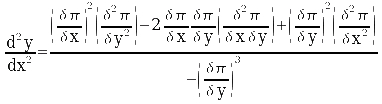
Edgeworth's Mathematical Psychics included a chapter on a bloody struggle that was going on, at the time he wrote it, entitled "The Present Crisis in Ireland". I leave you with this interesting function, reproduced in Heilbroner, which Edgeworth used in his analysis of the crisis. I like to think of it as "Edgeworth's Irish Nationalism Function":
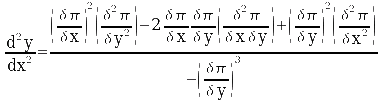
I discovered Francis Ysidro Edgeworth while flicking through Heilbroner's The Worldly Philosophers, looking for dirt on Stanley Jevons, one of the alleged inventors of consumption theory. Edgeworth was a contemporary of Jevons who, in 1881 published Mathematical Psychics a treatise on economics. According to Heilbroner (p171 in "my" copy):
... Edgeworth was not fascinated with economics because it justified or explained or condemned the world, or because it opened new vista, bright or gloomy, into the future. This odd soul was fascinated because economics dealt with quantities and because anything that dealt with quantities could be translated into mathematics...Heilbroner continues with a few remarks on Edgeworth's character:
To build up such a mathematical mirror of reality, the world obviously has tto be simplified. Edgeworth's simplification was this assumption: every man is a pleasure machine. [original emphasis, my literals and elisions]
Of all men to have adopted such a view of society, Edgeworth seems a most unlikely choice. Hehimself was as ill-constructed a pleasure machine as can be imagined. Neurotically shy, he tended to flee from the pleasures to the privacy of his club; unhappy about the burden of material things, he received few of the pleasures that for most people flow from possessions... Perhaps his greatest source of pleasure was in the construction of his lovely economic Xanadu.On reflection, I don't share Heilbroner's view that Edgeworth seems an unlikely person to have taken such a view of society - it's precisely the sort of idealised conception you might expect a neurotically shy person who shuns the pleasures of human company to take. And I'm inclined to doubt that his lovely economic Xanadu was his sole source of pleasure - my guess is that he had an impressively elaborate line in sexual fantasy as well. But given the era Edgeworth lived in, I'm happy to concur with Heilbroner's suggestion that the economic Xanadu was Edgeworth's greatest source of pleasure.
But regardless of his motives, Edgeworth's pleasure machine assumption bore wonderful intelletual fruit. For if economics was defined to be the study of human pleasure-mechanisms competing for shares of society's stock of pleasure, then it could be shown - with all the irrefutability of the differential calculus - that in a world of perfect competition each pleasure machine would achieve the highest amount of pleasure that could be meted out by society.
Edgeworth's character - neurotically shy, spartan, masturbative - would certainly explain his inability to understand why people, who ought if they were rational, to compete with each other for all the pleasure society had to offer - would insist on limiting their pleasures by combining in organisations such as trade unions (or more respectably, professional associations and chambers of commerce). Cut off from the pleasures of society by his shyness, he could not recognise that for most people, just hanging out is inherently enjoyable. And his intellectual solution to this problem - that hanging out, or combining with otheres to gain illusory "common benefit" is only effective in the short run and, in the long run, rationality, that is pure competition, will prevail is reminiscent of the chronic masturbator's belief that one day all the women in the world will come to their senses and break down his bedroom door.
Edgeworth's Mathematical Psychics included a chapter on a bloody struggle that was going on, at the time he wrote it, entitled "The Present Crisis in Ireland". I leave you with this interesting function, reproduced in Heilbroner, which Edgeworth used in his analysis of the crisis. I like to think of it as "Edgeworth's Irish Nationalism Function":
Wednesday, June 14, 2006
The Enchanted Toasting Fork - Episode 11
(Yes, I finally got my arse in front of the PC and got it written)
"OK, here goes," said Ruby, leaning back on the pillows, "The story of my bright, happy childhood ... You know, it would be a lot easier to believe you're actually interested in this if you'd stop that and just listen."
Petro stopped that and settled himself, rather elaborately; he moved closer to Ruby and with a show of casual nonchalance, managed to get his arm extended across the top of her head. She graciously took the hint, and settled herself on his shoulder, taking one arm out of play. That left his other hand free for that, but once Ruby had clasped it in twined fingers, that was pretty much out of the question. Ruby resumed her tale.
"So the fairy godmothers did their little number and that was that - everyone knew that, as usual, the christening was a right royal total stuff-up, but there was nothing anyone could do about it. So it was off to the palace dining room where the christening feast was laid out, and everyone did their best to put a good face on things with the help of the dozen cases of vintage champagne that had been put aside for the occasion, plus a dozen more that had been set aside for my Confirmation and then they started in on the Royal Wedding stock. It was the most monumental piss-up in the history of the kingdom. Hasn't been rivalled yet, apparently.
"I've only got this second hand, of course, but thanks to that business about 'always presenting a cheerful face to the world', I nearly starved to death within a couple of days of the christening. Normal babies cry when they're hungry - they don't smile angelically, giggle winsomely and then lapse into a coma. Fortunately for me the place physician was smart enough to realise what was what and he gave the wet nurse strict instructions to feed me every three hours during the day, whether I was crying or not."
Ruby drew herself a little closer to Petro; her body quivered against his, her hand trembled. He freed his hand from her grasp - not to do that, though he was tempted, but to draw her closer and, he hoped, still the vibrancy that seemed to be overwhelming her.
"We can skip the next bit, if it's too upsetting," he suggested, "Leave it for another time, perhaps."
"OK," she answered, "We'll skip my happy bright childhood and get tot the first of these ..."
She took hold of Petro's hand again, and guided it to the crest of her hip where a new chrysophrase had just pushed its way through her skin. "Of course, it wasn't a chrysophrase or a garnet - those started to come much later - it was a ruby, and a good sized one too." Petro's hand showed no signs of moving - his mind seemed to be completely off that - so she felt it was safe to move hers. She touched the tip of her nose.
"It was right here." she said.
"It came as a bit of a shock, but I was still stuck with showing a happy, vibrant face to the world, so everyone thought I was taking it in my stride. As if. Everyone in the palace quickly got used to seeing me with precious stones poking out of my complexion, so it needn't have been too bad.
"Except that the kingdom was in financial difficulties and my father had taken on a new Chancellor of the Exchequer whowas dead keen to get the Palace budget into surplus. And the rubies were quite valuable, even uncut. He talked my father into seeing 'fiscal sense' and I ended up in a well guarded room in the top of the highest tower in the palace, with a chamber maid to care for me and a professional appraiser to keep an eye on the rubies. Besides the armed guards at the bottom of the tower stairs, there were archers and falconers on watch round the battlements to make sure that no magpies, bower-birds or other thieving pests could get near me.
"Naturally, word got out that there was an enchanted princess locked in a tower of the Palace and the handsome Princes started to show up, all looking to fight their way past the guards, for the chance of a quick snog with yours truly. One finally turned up who was a little less half-witted than the rest - he brought a rope and a grappling hook and stole into the room by night. We snogged - I felt the magic lift - climbed down the rope and rode away on the obligatory white steed. It was an ex-police force Harley Electra Glide. A week later we were married.
"But that wasn't the end of the spell. Turns out that he wasn't a pure-bred royal. His mother had got a bit frisky with one of the gentlemen of the bed chamber while his Majesty, her husband had been off on a hunting trip or carousing with a couple of the ladies in waiting. Something like that. It happens a lot in royal circles. So I didn't turn out the perfect beauty he expected. And now the gems were nowhere as large and valuable as they used to be.
"After about six months I came home from opening a new health spa to find Prince Bastard and the most exfoliated of our ladies in waiting in bed together. We argued, I left, the next year there was agreat scandal when she brought a little quarter Princess into the world.
"And that's pretty much it," Ruby finished, with evident relief, "So, how did you get to be an out-of-work wizard?"
Petro didn't answer - his mind had wandered back to that and the task of convincing Ruby that, right now, that would be a lot more interesting than listening to his life story.
"OK, here goes," said Ruby, leaning back on the pillows, "The story of my bright, happy childhood ... You know, it would be a lot easier to believe you're actually interested in this if you'd stop that and just listen."
Petro stopped that and settled himself, rather elaborately; he moved closer to Ruby and with a show of casual nonchalance, managed to get his arm extended across the top of her head. She graciously took the hint, and settled herself on his shoulder, taking one arm out of play. That left his other hand free for that, but once Ruby had clasped it in twined fingers, that was pretty much out of the question. Ruby resumed her tale.
"So the fairy godmothers did their little number and that was that - everyone knew that, as usual, the christening was a right royal total stuff-up, but there was nothing anyone could do about it. So it was off to the palace dining room where the christening feast was laid out, and everyone did their best to put a good face on things with the help of the dozen cases of vintage champagne that had been put aside for the occasion, plus a dozen more that had been set aside for my Confirmation and then they started in on the Royal Wedding stock. It was the most monumental piss-up in the history of the kingdom. Hasn't been rivalled yet, apparently.
"I've only got this second hand, of course, but thanks to that business about 'always presenting a cheerful face to the world', I nearly starved to death within a couple of days of the christening. Normal babies cry when they're hungry - they don't smile angelically, giggle winsomely and then lapse into a coma. Fortunately for me the place physician was smart enough to realise what was what and he gave the wet nurse strict instructions to feed me every three hours during the day, whether I was crying or not."
Ruby drew herself a little closer to Petro; her body quivered against his, her hand trembled. He freed his hand from her grasp - not to do that, though he was tempted, but to draw her closer and, he hoped, still the vibrancy that seemed to be overwhelming her.
"We can skip the next bit, if it's too upsetting," he suggested, "Leave it for another time, perhaps."
"OK," she answered, "We'll skip my happy bright childhood and get tot the first of these ..."
She took hold of Petro's hand again, and guided it to the crest of her hip where a new chrysophrase had just pushed its way through her skin. "Of course, it wasn't a chrysophrase or a garnet - those started to come much later - it was a ruby, and a good sized one too." Petro's hand showed no signs of moving - his mind seemed to be completely off that - so she felt it was safe to move hers. She touched the tip of her nose.
"It was right here." she said.
"It came as a bit of a shock, but I was still stuck with showing a happy, vibrant face to the world, so everyone thought I was taking it in my stride. As if. Everyone in the palace quickly got used to seeing me with precious stones poking out of my complexion, so it needn't have been too bad.
"Except that the kingdom was in financial difficulties and my father had taken on a new Chancellor of the Exchequer whowas dead keen to get the Palace budget into surplus. And the rubies were quite valuable, even uncut. He talked my father into seeing 'fiscal sense' and I ended up in a well guarded room in the top of the highest tower in the palace, with a chamber maid to care for me and a professional appraiser to keep an eye on the rubies. Besides the armed guards at the bottom of the tower stairs, there were archers and falconers on watch round the battlements to make sure that no magpies, bower-birds or other thieving pests could get near me.
"Naturally, word got out that there was an enchanted princess locked in a tower of the Palace and the handsome Princes started to show up, all looking to fight their way past the guards, for the chance of a quick snog with yours truly. One finally turned up who was a little less half-witted than the rest - he brought a rope and a grappling hook and stole into the room by night. We snogged - I felt the magic lift - climbed down the rope and rode away on the obligatory white steed. It was an ex-police force Harley Electra Glide. A week later we were married.
"But that wasn't the end of the spell. Turns out that he wasn't a pure-bred royal. His mother had got a bit frisky with one of the gentlemen of the bed chamber while his Majesty, her husband had been off on a hunting trip or carousing with a couple of the ladies in waiting. Something like that. It happens a lot in royal circles. So I didn't turn out the perfect beauty he expected. And now the gems were nowhere as large and valuable as they used to be.
"After about six months I came home from opening a new health spa to find Prince Bastard and the most exfoliated of our ladies in waiting in bed together. We argued, I left, the next year there was agreat scandal when she brought a little quarter Princess into the world.
"And that's pretty much it," Ruby finished, with evident relief, "So, how did you get to be an out-of-work wizard?"
Petro didn't answer - his mind had wandered back to that and the task of convincing Ruby that, right now, that would be a lot more interesting than listening to his life story.
Monday, June 12, 2006
Duckspeak on Doublethink
According to Dr Jennifer Marohasy of the IPA:
Doublethink is when we hold two contradictory beliefs in our minds simultaneously and accept both of them. Doublethink has been described as a form of trained, willful blindness to contradictions ...Personally, I think that misses some of the subtleties of classic Orwellian doublethink, as outlined in the postscript to 1984, where Orwell describes his synthetic language, Newspeak and its usage. For example, the Newspeak word duckspeak can be used pejoratively, to dismiss the oratory of an opponent of IngSoc, or in praising a particularly good Party orator - who might be a doubleplusgood duckspeaker.
According to Dr Marohasy, Doublethink is rife in debate on the management of the Murray-Darling Basin - not at the IPA of course, but in the halls of academia, the smoky back-rooms of envirnmental activists, the halls of political power and of course, the offices of the bureaucrats. Take for example, Risks to the shared water resources of the Murray-Darling Basin, Part 2 of the MDBC's recent report on the state of the Basin, in particular, the section on Groundwater Extraction:
It begins by stating that "groundwater stores are declining at alarming rates and this may jeopardise its future use locally". It goes on to explain different ways that groundwater extraction can lead to reduced stream flows...The first thing that might strike you - it certainly struck me - about this beginning is the lower case "g" in groundwater. Surely, if the section begins with this statement, "groundwater" ought to be capitalised. Well, let's take a look at the section and see how it does begin:
Groundwater is a valuable resource in the Basin. As discussed in the first report in this two part series, groundwater extraction has increased in recent years. In some parts of the Basin, groundwater stores are declining at alarming rates and this may jeopardise its future use locally. [my emphasis]Well, Dr Marohasy's selected quote is near the beginning - it's no further than two full sentences and an adverbial phrase in. And I suppose Dr Marohasy's presentation of the quote is more accurate than something like this:
Groundwater ... stores are declining at alarming rates and this may jeopardise its future use locally.But then, if Dr Marohasy had gone that route, the prescence of an ellipsis would have given a lot of readers the hint that the quote was being massaged a little, in the manner of book blurbs and movie posters.
Ah, but where is the double think? Probably here:
Read on [for about two pages of technical discussion] and there is reference to high levels of groundwater extraction in the Shepparton-Katunga region contributing to salinity mitigation...So there you have it - groundwater extraction bad, because it may jeopardise groundwater supplies (locally) into the future, groundwater extraction good because it mitigates salinity. Except that according to Dr Marohasy, we're not really talking about groundwater extraction in the Shepparton-Katunga region - it's actually:
... code for salt interception schemes are a form of groundwater extraction. [sic]And here's what the report actually says about the Shepparton-Katunga region:
Other areas where extraction rates are high at present, such as the Shepparton-Katunga and Lower Murrumbidgee regions, have a similarly high level of risk [of environmental damage, particularly to rivers fed by the groundwater aquifers - I think]. However, the situation here is complicated by the presence of a semi-confining layer. In the Shepparton-Katunga region, high levels of extraction contribute to salinity mitigation.From here on, Dr Marohasy's post lapses into confusion, as she works hew way to posing the question:
But hang-on, how much lower do we want to push Murray River salt levels and what is the tradeoff in terms of lost groundwater?Lost? The report says nothing about lost groundwater - unless you count groundwater that can't be extracted from aquifers, because the result is an adverse impact on river water quality, as "lost". Read on, and the confusion culminates in this parting question:
At what point will there be a realization that river salinity and rising groundwater are no longer key issues, the real issue is disappearing groundwater and it is likely to be exacerbated by the next salt interception scheme?I'd like to know where this groundwater is disappearing to. Is there, perhaps, some process of cold fusion going on in Murray-Darling basin aquifers that is turning some of the water into helium and free oxygen? If so, that wouldn't be such a bad thing, if we could find a way to harness to energy that's being released - it might be bad news for the Murray, but it's good news for greenhouse gas emissions.
(Cross-posted at Larvatus Prodeo)
Friday, May 26, 2006
Qu(ot)e?
(And maybe some good news on species extinction)
Well, it's stacks on the mill over at Larvatus Prodeo, now that some idiot has let slip to Dr Jennifer Marohasy that yours truly had doen a bit of a hatchet job on her recent post on salinity in the Murray River. So much for the spell of ennui I was planning for the rest of this week and most of the next - I may have to go with the schadenfreude option instead. Fine by me, as long as I'm not the one providing the schadenfreude.
Moving right along, in a spirit of something approaching fair-mindedness, I recently downloaded Dr Marohasy's IPA backgrounder Myth & the Murray: Measuring the real state of the river environment (PDF) from the IPA site. So far I've only had time to skim the report, but this section piqued my interest:
I have no major disagreement with that last paragraph - I remember applying much the same principle in my own science education, years ago. If, for example, you wanted to check whether a stream was contaminated with E coli, you'd go out, collect water samples at various locations, take them back to the lab and then put yourself through the tedious business of mixing measured amounts of stream water with nutrient medium, incubate the mixture for a known period (corresponding to a calculable number of bacterial reproductive cycles), serially dilute the resultant cloudy broth then pour measured amounts onto agar plates. Once you got that done, you got to the fun bit - using the dinky colony counter machine to mark all the bacterial colonies on your agar plate, while the counter mechanism clicked over every time you pressed the special marker pen on the base of the plate.
The trouble was, if your agar plates were clean, you'd miss out on the fun bit with the colony counter. To make matters worse, you would have to conclude, on the basis of the available data, that the stream was totally uncontaminated by any bacteria, let alone E coli. Apparently, though, good scientists don't take this approach when it comes to the question of whether a river is contaminated by a particular species of fish. Finding no fish in the river, despite your best efforts to do so, is not enough evidence to infer that the river is most likely fish free. Well, you live and learn.
I suppose the same principle applies to potential bird contamination of wind-farm sites - well, it does according to Ian Campbell. All up, this has to be good news when it comes to species we used to think were extinct - for example, the continental USA is widely believed, on the available data, to be completely uncontaminated by Passenger Pigeons and the island of Mauritius, on the same grounds, is considered free of Dodo contamination. But clearly, we've got it wrong. Any day now, these lost species might turn up, like one of those two dollar coins that starts making an almighty ruckus when it falls out of one of your pockets in the clothes dryer. And for all we know, there might well be a few piles of unicorn manure somewhere that have been mistaken for the horse variety. no good scientist could rule ou the possiblity out on the grounds that everyone "knows" that unicorns aren't real.
Nah - I think I might take the ennui option anyhow. Too many pieces in the "to-be-completed" queue - like the next episode of that damned serial. And I owe myself at least a few hours of relaxing to great symphonies with rushed openings, missing repeated sections and sub-standard maestoso passages.
Well, it's stacks on the mill over at Larvatus Prodeo, now that some idiot has let slip to Dr Jennifer Marohasy that yours truly had doen a bit of a hatchet job on her recent post on salinity in the Murray River. So much for the spell of ennui I was planning for the rest of this week and most of the next - I may have to go with the schadenfreude option instead. Fine by me, as long as I'm not the one providing the schadenfreude.
Moving right along, in a spirit of something approaching fair-mindedness, I recently downloaded Dr Marohasy's IPA backgrounder Myth & the Murray: Measuring the real state of the river environment (PDF) from the IPA site. So far I've only had time to skim the report, but this section piqued my interest:
The Cooperative Research Centre (CRCFE) survey Fish and Rivers in Stress: The NSW Rivers Survey is generally considered the most comprehensive survey of fish in the Murray–Darling Basin. The survey does not provide any data from which trends with respect to improvement or deterioration in fish numbers can be determined. However, the survey undertaken in the mid-1990s does claim to give an indication of the abundance of fish in the Murray River relative to other rivers.
The report’s principal conclusions include that ‘A telling indication of the condition of rivers in the Murray region was the fact that, despite intensive fishing with the most efficient types of sampling gear for a total of 220 person-days over a two-year period in 20 randomly chosen Murray-region sites, not a single Murray cod or freshwater catfish was caught.’ [Dr Marohasy's emphasis]
A good scientist is usually wary of an absence of data. An absence of data (namely, catching no fish) could be an indication that, for example, they got their sampling method (that is, their fishing technique) wrong, rather than that there were no fish.
I have no major disagreement with that last paragraph - I remember applying much the same principle in my own science education, years ago. If, for example, you wanted to check whether a stream was contaminated with E coli, you'd go out, collect water samples at various locations, take them back to the lab and then put yourself through the tedious business of mixing measured amounts of stream water with nutrient medium, incubate the mixture for a known period (corresponding to a calculable number of bacterial reproductive cycles), serially dilute the resultant cloudy broth then pour measured amounts onto agar plates. Once you got that done, you got to the fun bit - using the dinky colony counter machine to mark all the bacterial colonies on your agar plate, while the counter mechanism clicked over every time you pressed the special marker pen on the base of the plate.
The trouble was, if your agar plates were clean, you'd miss out on the fun bit with the colony counter. To make matters worse, you would have to conclude, on the basis of the available data, that the stream was totally uncontaminated by any bacteria, let alone E coli. Apparently, though, good scientists don't take this approach when it comes to the question of whether a river is contaminated by a particular species of fish. Finding no fish in the river, despite your best efforts to do so, is not enough evidence to infer that the river is most likely fish free. Well, you live and learn.
I suppose the same principle applies to potential bird contamination of wind-farm sites - well, it does according to Ian Campbell. All up, this has to be good news when it comes to species we used to think were extinct - for example, the continental USA is widely believed, on the available data, to be completely uncontaminated by Passenger Pigeons and the island of Mauritius, on the same grounds, is considered free of Dodo contamination. But clearly, we've got it wrong. Any day now, these lost species might turn up, like one of those two dollar coins that starts making an almighty ruckus when it falls out of one of your pockets in the clothes dryer. And for all we know, there might well be a few piles of unicorn manure somewhere that have been mistaken for the horse variety. no good scientist could rule ou the possiblity out on the grounds that everyone "knows" that unicorns aren't real.
Nah - I think I might take the ennui option anyhow. Too many pieces in the "to-be-completed" queue - like the next episode of that damned serial. And I owe myself at least a few hours of relaxing to great symphonies with rushed openings, missing repeated sections and sub-standard maestoso passages.
On the Domestic Front ...
Warning: this post includes information that may spoil your enjoyment of a favourite piece of recorded music.
Zeppo Bakunin's been on my case over the past couple of days on the subject of music theory - he reckons I should get into it as a hobby. All I'd need do, initially at least, is take myself off to the local library, or the second hand book shops, and start tracking down text books and other works of reference. And maybe a few miniature scores as well. Then perhaps I could start blogging on the subject of musical recordings and dishing the dirt on conductors who rush the openings of violin concerti or skip repeats in the last movements of famous symphonies. Or, a particular gripe that makes one set of CDs I've got more or less unbearable to listen to, record important sections of major choral works with key instruments in the orchestral score completely missing. It's a flute playing counterpoint grace notes to a trumpet part, for anyone who might be interested, and hearing the phantom notes in my head just isn't the same.
It sounds like a good idea as it would combine quite nicely with the blogging hobby, and I might eventually end up with the web-site to visit for tips on how to buy classical recordings. Such as - any conductor who gets through the fourth movement of Saint-Saens' Symphony No 3 op 78 (the "Organ Symphony") in less than 8' 28 is stiffing you on the Maestoso. That benchmark is taken from a 1982 Karajan recording. I chose it because, out of all the recordings available in the record shop where I bought it, it had the longest final movement. Old Herbie must have slowed down in his later years.
It also sounds like a bad idea - because right now, some of you at least, are looking at your CD racks where the Saint-Saens' Symphony No 3 enoys pride of place, thinking I really don't want to know. Bugger that Gummo Trotsky for bringing the subject up at all.
Zeppo Bakunin's been on my case over the past couple of days on the subject of music theory - he reckons I should get into it as a hobby. All I'd need do, initially at least, is take myself off to the local library, or the second hand book shops, and start tracking down text books and other works of reference. And maybe a few miniature scores as well. Then perhaps I could start blogging on the subject of musical recordings and dishing the dirt on conductors who rush the openings of violin concerti or skip repeats in the last movements of famous symphonies. Or, a particular gripe that makes one set of CDs I've got more or less unbearable to listen to, record important sections of major choral works with key instruments in the orchestral score completely missing. It's a flute playing counterpoint grace notes to a trumpet part, for anyone who might be interested, and hearing the phantom notes in my head just isn't the same.
It sounds like a good idea as it would combine quite nicely with the blogging hobby, and I might eventually end up with the web-site to visit for tips on how to buy classical recordings. Such as - any conductor who gets through the fourth movement of Saint-Saens' Symphony No 3 op 78 (the "Organ Symphony") in less than 8' 28 is stiffing you on the Maestoso. That benchmark is taken from a 1982 Karajan recording. I chose it because, out of all the recordings available in the record shop where I bought it, it had the longest final movement. Old Herbie must have slowed down in his later years.
It also sounds like a bad idea - because right now, some of you at least, are looking at your CD racks where the Saint-Saens' Symphony No 3 enoys pride of place, thinking I really don't want to know. Bugger that Gummo Trotsky for bringing the subject up at all.
Saturday, May 20, 2006
Philosopher Cornered
(There's a title I've used before, but what the hell)
A [man] finds in himself a talent whose cultivation would make him a useful man for all sorts of purposes. But he sees himself in comfortable circumstances, and he prefers to give himself up to pleasure rather than to bother about increasing and improving his fortunate natural aptitudes. Yet he asks himself further "Does my maxim of neglecting my natural gifts, besides agreeing in itself with my tendency to indulgence, agree also with what is called duty?" He then sees that a system of nature could indeed always subsist under such a universal law, although (like the South Sea Islanders) every man should let his talents rust and should be bent on devoting his life solely to idleness, indulgence, procreation, and, in a word, to enjoyment. Only he cannot possibly will that this should become a universal law of nature or should be implanted in us as such a law by a natural instinct. For as a rational being he necessarily wills that all his powers should be developed, since they serve him, and are given him, for all sorts of possible ends.That's the third of four examples Kant uses to illustrate the application of Categorical Imperative No 2, "The Formula of the Law of Nature", to wit:
Immanuel Kant Groundwork of the Metaphysic of Morals (my literals & glosses)
Act as if the maxim of your action were to become through your will a universal law of nature.
Kant's argument here, roughly nutshelled, is that if every talented person in the world acted like those South Sea Islanders and lounged around drinking and passing around social diseases all day, not a lot of work would get done and a lot of people - except those with natural aptitudes for drinking and innovative fornication - would waste their God-given talents. Personally, I don't share Kant's conviction that this would necessarily be a bad thing. Neither, apparently did the crew of The Bounty, among others.
What sort of talents would it take to make a man useful for all sorts of purposes? We needn't concern ourselves with women. After all Kant didn't - philosophical legend (which I've checked with various members of philosophy faculties over the years) has it that he died a virgin. Apparently his own duty to cultivate his natural talents didn't extend to passing it on to the next generation. That's a little ungenerous - let's give due consideration to the possibility that even in Eighteenth Century Germany "It's your duty to help me perpetuate my philosophical genius into the future" would have been a lousy pick-up line.
Leaving aside Kant's obviously useful, and scrupulously cultivated, talent for philosophy, the field is pretty well wide open. As long as it makes us useful men. For some purpose, or purposes. To whom we have to be useful and how is left pretty open. And look, discriminatory as it might appear, I am going to leave the women out of this because I've go no intention of buying into a big blog-fight by telling women how to make themselves useful.
So let's suppose our hypothetical man discovers that his natural talents are for sycophancy, bullying and manipulation. In modern society, he can find any number of opportunities to make himself useful - to society at large, as a politician, to the shareholders of a corporation as their CEO. And in whatever capacity he employs his talent to make himself useful to others, you can be sure it will be equally useful to himself. If not more so.
Obviously such an individual - sorry, such a man - is duty bound to nurture those talents, even if he has the means to take himself off to the South Seas for a life of more or less carefree carousal with the occasonal interlude of bed rest and antibiotics. And even though the rest of us might wish that a man so blessed with wealth and natural talent would take the South Seas option, the Kantian position is pretty clear. Some people just have to be bastards and that's the way it should be.
Wednesday, May 10, 2006
Budget 2006 - The Good, The Bad and The Ugly
Budget 2006 - The Good
The existence of Desmond Benson, vox-popped in the budget special liftout in today's Age:
The BadI'd like the tax system and the welfare system to be better organised so that people don't pay effective marginal tax rates of 70 per cent or higher. It doesn't impact on us and I think we're very lucky to have a high income (but) I think there are others who should get the benefits of any improvements becaue they deserve it more.
This Official DHS Media Release (PDF):
As part of the 2006–07 Federal Budget, Human Services Minister Joe Hockey MP today announced further details of the new health and social services access card.
The introduction of the new access card will cut some of the red tape involved in obtaining health and social services benefits, whilst delivering a more convenient, efficient and secure system for obtaining Government health and social services benefits.
...
The access card will be phased in over a two year registration period beginning in early 2008. From early 2010, people will only be able to access Government health and social services benefits if they have an access card.
The Ugly
This massive injection of funds into a single CentreLink program:
| Estimated actual 2005-06 $'000 | Budget estimate 2006-07 $'000 | |
| Departmental appropriations Output Group 1.1 - Effective and Efficient delivery of Government services | 250 | 636,936 |
| Subtotal Output Group 1.1 | 250 | 636,936 |
Page 92 - DHS Portfolio Budget Statements (PDF)
That might look like a 25400% spending increase - and cause you to wonder how the tax cuts are being funded - but it's a cheap little piece of hide-and-seek bureaucratic accounting. With all CentreLink expenditure for the future now billed as a single item, you have to wade through pages of detail to find out how much CentreLink is spending on Compliance Control.
I think I might come back to this one tomorrow, after I've given myself a few hours to find the right side of the bed again. Sod it - I'll give it until Monday.
(Cross-posted at Larvatus Prodeo)
One For Dave
My registration at Friends Reunited finally paid off last night - I got an e-mail telling me that I had a message from an ex-schoolmate at Greenfields High who I more or less liked. He was part of the same hopeless-at-footy-and-cricket, Doctor-Who-and-Goon-Show-fan, totally-fringe-weirdo crowd that I was in for my last three years of high school.
I'm not sure I should have written that last sentence - by way of an answer to his question about what I've been up to in the last thirty-three years I sent him the address of this blog and that other one, where some, but not all, of the grubby details of my life since school are laid bare for all the world to see. With the emphasis on grubby, since that's the font et origo of most of the stuff I pass off as humour.
It's about time that registration at Friends Reunited paid off. OK, so the past four years I've been getting what I paid for - a list of footy-and-cricket-adept boofheads with whom I had little in common then, even less now, and one or two people who might be worth contacting. And some interesting where are they now stuff which generally shows that the kids who got streamed out of school in Form 4, or earlier, and went off to seek opportunities elsewhere, often did a lot better in life than us mugs who stuck out the full sentence in the hope of achieving academic excellence. My favourite example of that is the totally dysfunctional kid who joined the army as an apprentice, worked his way up to Major, and went overseas a couple of times on peacekeeping operations.
That's enough of that for now - I've got to see if I can track down a hand cranked laundry mangle on E-Bay. I'm going to need one if I adopt one suggestion I got in response to this post at Larvatus Prodeo that I cut down my laudromat costs by hand-washing everything - including towels and bed linen. If I can't find one, I'll probably have to go all third world and find a stretch of the Moonee Ponds Creek where I can bang the sheets on the bikepath or the concrete embankment.
I'm not sure I should have written that last sentence - by way of an answer to his question about what I've been up to in the last thirty-three years I sent him the address of this blog and that other one, where some, but not all, of the grubby details of my life since school are laid bare for all the world to see. With the emphasis on grubby, since that's the font et origo of most of the stuff I pass off as humour.
It's about time that registration at Friends Reunited paid off. OK, so the past four years I've been getting what I paid for - a list of footy-and-cricket-adept boofheads with whom I had little in common then, even less now, and one or two people who might be worth contacting. And some interesting where are they now stuff which generally shows that the kids who got streamed out of school in Form 4, or earlier, and went off to seek opportunities elsewhere, often did a lot better in life than us mugs who stuck out the full sentence in the hope of achieving academic excellence. My favourite example of that is the totally dysfunctional kid who joined the army as an apprentice, worked his way up to Major, and went overseas a couple of times on peacekeeping operations.
That's enough of that for now - I've got to see if I can track down a hand cranked laundry mangle on E-Bay. I'm going to need one if I adopt one suggestion I got in response to this post at Larvatus Prodeo that I cut down my laudromat costs by hand-washing everything - including towels and bed linen. If I can't find one, I'll probably have to go all third world and find a stretch of the Moonee Ponds Creek where I can bang the sheets on the bikepath or the concrete embankment.
Thursday, May 04, 2006
Announcing - Slag Off The Green Guide Thursday!
(A Potemkin community service for Melbourne readers)
Gummo's Green Guide highlights:
Feel free to add your own Green Guide highlights in the comments.
Gummo's Green Guide highlights:
Preview (p 17):What's next Paul? A TV series with a Godot-type protagonist? Hang on, the ABC's actually got one of those - the English crime series Taggart.
All About My Mother kicks off with a reference to All About Eve the shrew 1950s melodrama about scheming, competitive actresses ...
(Paul Kalina reviewing the Movie of the Week)
The last time Rebus graced our screens he was portrayed by the elegant John Hannah, who was solid but lacked the right gravitas. Hannah availed himself very well through four instalments but he was never much like Rankin's creation ...
(Chris Middendorp reviews Rebus)
Critic's View (p 22):
Jim Schembri gives The Alan Clark Diaries its first Green Guide review. Pity it's a week too late. To Jim's credit, he does manage to restrict the obligatory snark about a crap program to two pithy paragraphs.
Movies (p 26):
In 1940s Montana, three ranchers are caught up in an essential struggle for survival; one is a tragic, King Lear-type villain (played by Jason Robards) who hopes to usurp the land of his neighbour and former lover ...
(Paul Kalina again, this time on Comes a Horseman)
Feel free to add your own Green Guide highlights in the comments.
Sunday, April 30, 2006
My Name Ain't Legion (Mark 5:9). Got That?
Unlike Andrew Bartlett, I haven't exactly been open about having depression over the past few years, except to friends, family and my personal brain-care specialist. On the other hand, I have thrown out enough hints here and there, so I might as well step all the way out of the closet and admit that I have a yappy little black terrier of my very own. I share Senator Bartlett's interest in the way depression is perceived, portrayed and dealt with - and this page on the Hillsong web-site - written by American evangelical crap-artist Marilyn Hickey - makes me bloody angry.
According to Hickey who has been "Covering the Earth with the Word" (Isaiah 11:9) for over 30 years as an anointed Bible teacher:
According to Hickey who has been "Covering the Earth with the Word" (Isaiah 11:9) for over 30 years as an anointed Bible teacher:
... depression is a supernatural spirit of destruction straight from the devil, and as such, needs to be treated like an enemy.
Friday, April 28, 2006
Doctor's Orders
My personal brain-care specialist wants me off the smokes in the next couple of weeks. I'm also supposed to flog a piece of writing and make some actual ready money out of my literary talents.
Bugger of a thing to have laid on you two days after you've written a couple of posts with obvious commercial potential and thrown them into the public domain for free. Maybe I'll come across something promising next Argus day. Or I could go back a couple of days to read up on Hiram Maxim's lightweight steam engine for aerial navigation by aeroplane.
Bugger of a thing to have laid on you two days after you've written a couple of posts with obvious commercial potential and thrown them into the public domain for free. Maybe I'll come across something promising next Argus day. Or I could go back a couple of days to read up on Hiram Maxim's lightweight steam engine for aerial navigation by aeroplane.
Qu(ot)e?
Hugh Morgan, former CEO of Western Mining Corporation, has caused a bit of a kerfuffle locally, with his comments on dual nationality, reported in The Age, yesterday:
BUSINESS leader Hugh Morgan has called for dual citizenship to be outlawed, comparing it to having a mental illness.
More on Hugh and his personal eminence-grise at Crikey. And you can read him in his own write at Henry Thornton's website. Here's a little gem which will have a lot of you feeling well below par:
The average Australian is more than $83,000 better off in real wealth terms (in today's dollars) as a direct result of the economic reforms of the past 20 years.
(cross-posted at Larvatus Prodeo)
BUSINESS leader Hugh Morgan has called for dual citizenship to be outlawed, comparing it to having a mental illness.
In a speech at Deakin University last night, the prominent Liberal Party supporter and former Business Council chairman said a person with dual citizenship had "at least the beginning of a bipolar disorder".
Mr Morgan said citizenship was one of the most important elements of personal identity and would have a bearing on Australia's survival as a nation.
"I am convinced that if we took Australian citizenship seriously, we would not tolerate this bipolarity. If you are an Australian then that should be the end of the matter," he said.
...
Mr Morgan also weighed into the "culture wars", backing John Howard's criticism of the "dumbing down" of English teaching in Australian schools due to postmodernism and political correctness. He said post-modernism — which he defined as the belief that all versions of the truth were equally valid — threatened to cut the link between generations of Australians.
On today's Letters and opinion pages, Hugh cops a well deserved pasting for his remarks on dual nationality, which show two things; firstly that the Big End of Town is also the thick end of town and secondly, that Hugh might have served the mining industry much better as a pit-prop.More on Hugh and his personal eminence-grise at Crikey. And you can read him in his own write at Henry Thornton's website. Here's a little gem which will have a lot of you feeling well below par:
The average Australian is more than $83,000 better off in real wealth terms (in today's dollars) as a direct result of the economic reforms of the past 20 years.
(cross-posted at Larvatus Prodeo)
Sunday, April 23, 2006
Tuesday, April 18, 2006
Wanted to Borrow
Anyone know where I can lay my hands on a digital camera body with a Pentax compatible lens mount? Just askin'.
(OK, so I had this idea for a little photographic project this afternoon but, really, that ought to be obvious from the fact that I'm asking for a camera).
(OK, so I had this idea for a little photographic project this afternoon but, really, that ought to be obvious from the fact that I'm asking for a camera).
Local Legend
CHARGES AGAINST A CONSTABLE
DRUNKENNESS AND ASSAULT
Two charges against a constable by his superiors were heard before the Williamstown Bench yesterday... The Bench was composed of Messrs. Woods (mayor) and Douch , J.P. The defendant was William Considine , a constable stationed in Williamstown, who was charged by Richard John Webb, inspector of police, first, with being drunk while on duty, which was an act of misconduct against the discipline of the police force; and secondly, with assaulting Senior-constable Dyer, which also was an acto of misconduct against the discipline of the force. Mr Croker appeared for the defence. The witnesses were ordered out of court.DRUNKENNESS AND ASSAULT
Joseph D. Dyer, senior constable, stated that on the night of the 4th inst, he sought for Considine but could not find him. He called up Sergeant Oliver, and the two searched again and found Considine in a right of way near the Woolpack Hotel, talking to two civilians. He was not in a fit state for duty. Sergeant Oliver and witness tried to persuade him to go home. He then struck witness a heavy blow in the face. Witness threw defendant, who, as he got up, drew his handcuffs to attack witness, but he threw him again. His language was very bad. Sergeant Oliver and witness handcuffed and took him to the guard-room at the police station. On the way he was very violent, and kicked witness in the legs, and bit him.
George Oliver, police sergeant, corroborated this evidence. He had always found Considine an upright, honest constable, and very truthful. He was assaulted a few months ago by larrikins and seriously injured in the head, and since then it could be readily noticed when he had taken drink.
James Evans, constable, deposed that when Considine was in the guard-room he was "outrageous" and "wild," and several times rushed at Dyer kicking at him.
Mr Croker, addressing the Bench, said the defendant had received an injury to his brain which affected him and caused him to be irritable. It would not be denied that he acted as alleged by the witnesses, but the state of his brainled to his not being responsible for his actions.
Dr MacLean gave evidence briefly on the effect of Considine's injuries upon his temperament.
The Bench after a long deliberation, announced that it was of the opinion theere was an attempt at assault under great provocation, but there was not sufficient evidence that an assault had been committed. The case would therefore be dismissed.
The decision was received with applause in the body of the court.
Inspector Webb said he would now enter upon the charge of drunkenness while on duty.
Senior constable Dyer, Sergeant Oliver and Constable Evans gave evidence that in their opinion Considine was drunk on the occasion referred to, which was corroborated by Constable Bolger, the lock-up keeper. The Bench, after a long consultation, held that there was a doubt in the case, as the defendant was under great excitement. The benefit of the doubt was given to the defendant and the case dismissed. This announcement was received with applause.
(The Argus, 13 January 1892)
Monday, April 17, 2006
Pejorative, Bloggers for The Use Of
While pottering around in my backroom wordsmithery the other day, I came up with a new acronym that might just fill a need: NOOMPTY. It stands for "Not Out of My Pocket, Thank You!" Noompties are those voters with very sensitive hip pocket nerves whose opinions - usually at second or third hand, throught the writings of the opinionistas and politicos - dominate so much of the debate on social and economic policy these days. They are closely related to nimbies, indeed the two conditions are not mutually exclusive.
And while I was planning to work "Noompty" into a future post, it seems a little contrived to go looking for an issue that will give me an excuse to use it. So do feel free to pick it up and use it yourselves.
And while I was planning to work "Noompty" into a future post, it seems a little contrived to go looking for an issue that will give me an excuse to use it. So do feel free to pick it up and use it yourselves.
Sunday, April 16, 2006
Sometime Soon...
... I'm expecting the telephone to ring. I'll say "Hello" in a cheery, "come on speak to me" way.
The caller will respond "Good afternoon," (it will actually be early evening) "could I speak to Mr Trotsky, please?"
"This is Mr Trotsky speaking."
"Mr Trotsky, this is Noelene, I'm ringing on behalf of the Australian Direct Marketing Association. Are you aware of the work of the Association?"
"Look, I'm actually expecting an important call some time soon, I need the line free."
"Mr Trotsky, the ADMA is the industry body representing direct marketers in Australia. The Association is very concerned about recent legislation which may adversely affect employment in the industry. Are you aware of the recent legislation?"
"Could you please get off the line. I'm expecting an important call."
"Mr Trotsky, are you aware that the Federal government's 'Do Not Call' register for households who do not want to receive calls from telemarketers could cut employment in the local industry by as much as ten per cent and force Australian jobs off-shore?"
"Bloody hell, Noelene, if you're going to make your living talking to complete strangers on the telephone, show some bloody self-respect and get into the phone sex industry. Now get off the friggin' line!"
"Mr Trotsky, we were wondering if you, as a concerned member of the community, would be willing to circulate a petition, on behalf of the ADMA, calling for the register to be scrapped?"
"No I f*cking wouldn't!"
And then I'll hang up.
The caller will respond "Good afternoon," (it will actually be early evening) "could I speak to Mr Trotsky, please?"
"This is Mr Trotsky speaking."
"Mr Trotsky, this is Noelene, I'm ringing on behalf of the Australian Direct Marketing Association. Are you aware of the work of the Association?"
"Look, I'm actually expecting an important call some time soon, I need the line free."
"Mr Trotsky, the ADMA is the industry body representing direct marketers in Australia. The Association is very concerned about recent legislation which may adversely affect employment in the industry. Are you aware of the recent legislation?"
"Could you please get off the line. I'm expecting an important call."
"Mr Trotsky, are you aware that the Federal government's 'Do Not Call' register for households who do not want to receive calls from telemarketers could cut employment in the local industry by as much as ten per cent and force Australian jobs off-shore?"
"Bloody hell, Noelene, if you're going to make your living talking to complete strangers on the telephone, show some bloody self-respect and get into the phone sex industry. Now get off the friggin' line!"
"Mr Trotsky, we were wondering if you, as a concerned member of the community, would be willing to circulate a petition, on behalf of the ADMA, calling for the register to be scrapped?"
"No I f*cking wouldn't!"
And then I'll hang up.
Subscribe to:
Posts (Atom)