Does the world really work this way? To a very real degree it did in the days of Adam Smith. Even in his time, of course, there were already factors that acted as restraints against the free operation of the market system... And already there were more disquieting signs to be read. The Lombe brothers' factory was more than a mere marvel of engineering and a source of wonderment to the visitor: it betokened the coming of large scale industry and the emergence of individual employers who were immensely powerful individual actors in the market...I immediately decided that I had to know more about these Lombe brothers, especially given Heilbroner's description of working conditions in the factory:
Monday, June 19, 2006
The Fabulous Lombe Brothers
Isn't serendipity wonderful? After writing up Francis Ysidro Edgeworth (one of the late nineteenth century founding fathers of modern economics), I decided to go back to the beginning of Heilbroner's The Worldly Philosophers and, yes, actually read the whole book. Several pages into the chapter on Adam Smith, after I'd read Heilbroner's exposition of Smith's theory of the market, I found this:
Sunday, June 18, 2006
Francis Ysidro Edgeworth (1845-1926)
Another Great Dickhead of History
I discovered Francis Ysidro Edgeworth while flicking through Heilbroner's The Worldly Philosophers, looking for dirt on Stanley Jevons, one of the alleged inventors of consumption theory. Edgeworth was a contemporary of Jevons who, in 1881 published Mathematical Psychics a treatise on economics. According to Heilbroner (p171 in "my" copy):
Edgeworth's character - neurotically shy, spartan, masturbative - would certainly explain his inability to understand why people, who ought if they were rational, to compete with each other for all the pleasure society had to offer - would insist on limiting their pleasures by combining in organisations such as trade unions (or more respectably, professional associations and chambers of commerce). Cut off from the pleasures of society by his shyness, he could not recognise that for most people, just hanging out is inherently enjoyable. And his intellectual solution to this problem - that hanging out, or combining with otheres to gain illusory "common benefit" is only effective in the short run and, in the long run, rationality, that is pure competition, will prevail is reminiscent of the chronic masturbator's belief that one day all the women in the world will come to their senses and break down his bedroom door.
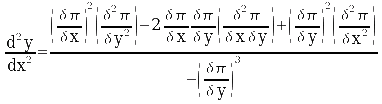
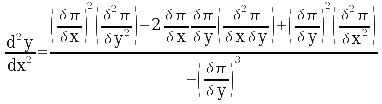
Edgeworth's Mathematical Psychics included a chapter on a bloody struggle that was going on, at the time he wrote it, entitled "The Present Crisis in Ireland". I leave you with this interesting function, reproduced in Heilbroner, which Edgeworth used in his analysis of the crisis. I like to think of it as "Edgeworth's Irish Nationalism Function":
I discovered Francis Ysidro Edgeworth while flicking through Heilbroner's The Worldly Philosophers, looking for dirt on Stanley Jevons, one of the alleged inventors of consumption theory. Edgeworth was a contemporary of Jevons who, in 1881 published Mathematical Psychics a treatise on economics. According to Heilbroner (p171 in "my" copy):
... Edgeworth was not fascinated with economics because it justified or explained or condemned the world, or because it opened new vista, bright or gloomy, into the future. This odd soul was fascinated because economics dealt with quantities and because anything that dealt with quantities could be translated into mathematics...Heilbroner continues with a few remarks on Edgeworth's character:
To build up such a mathematical mirror of reality, the world obviously has tto be simplified. Edgeworth's simplification was this assumption: every man is a pleasure machine. [original emphasis, my literals and elisions]
Of all men to have adopted such a view of society, Edgeworth seems a most unlikely choice. Hehimself was as ill-constructed a pleasure machine as can be imagined. Neurotically shy, he tended to flee from the pleasures to the privacy of his club; unhappy about the burden of material things, he received few of the pleasures that for most people flow from possessions... Perhaps his greatest source of pleasure was in the construction of his lovely economic Xanadu.On reflection, I don't share Heilbroner's view that Edgeworth seems an unlikely person to have taken such a view of society - it's precisely the sort of idealised conception you might expect a neurotically shy person who shuns the pleasures of human company to take. And I'm inclined to doubt that his lovely economic Xanadu was his sole source of pleasure - my guess is that he had an impressively elaborate line in sexual fantasy as well. But given the era Edgeworth lived in, I'm happy to concur with Heilbroner's suggestion that the economic Xanadu was Edgeworth's greatest source of pleasure.
But regardless of his motives, Edgeworth's pleasure machine assumption bore wonderful intelletual fruit. For if economics was defined to be the study of human pleasure-mechanisms competing for shares of society's stock of pleasure, then it could be shown - with all the irrefutability of the differential calculus - that in a world of perfect competition each pleasure machine would achieve the highest amount of pleasure that could be meted out by society.
Edgeworth's character - neurotically shy, spartan, masturbative - would certainly explain his inability to understand why people, who ought if they were rational, to compete with each other for all the pleasure society had to offer - would insist on limiting their pleasures by combining in organisations such as trade unions (or more respectably, professional associations and chambers of commerce). Cut off from the pleasures of society by his shyness, he could not recognise that for most people, just hanging out is inherently enjoyable. And his intellectual solution to this problem - that hanging out, or combining with otheres to gain illusory "common benefit" is only effective in the short run and, in the long run, rationality, that is pure competition, will prevail is reminiscent of the chronic masturbator's belief that one day all the women in the world will come to their senses and break down his bedroom door.
Edgeworth's Mathematical Psychics included a chapter on a bloody struggle that was going on, at the time he wrote it, entitled "The Present Crisis in Ireland". I leave you with this interesting function, reproduced in Heilbroner, which Edgeworth used in his analysis of the crisis. I like to think of it as "Edgeworth's Irish Nationalism Function":
Wednesday, June 14, 2006
The Enchanted Toasting Fork - Episode 11
(Yes, I finally got my arse in front of the PC and got it written)
"OK, here goes," said Ruby, leaning back on the pillows, "The story of my bright, happy childhood ... You know, it would be a lot easier to believe you're actually interested in this if you'd stop that and just listen."
Petro stopped that and settled himself, rather elaborately; he moved closer to Ruby and with a show of casual nonchalance, managed to get his arm extended across the top of her head. She graciously took the hint, and settled herself on his shoulder, taking one arm out of play. That left his other hand free for that, but once Ruby had clasped it in twined fingers, that was pretty much out of the question. Ruby resumed her tale.
"So the fairy godmothers did their little number and that was that - everyone knew that, as usual, the christening was a right royal total stuff-up, but there was nothing anyone could do about it. So it was off to the palace dining room where the christening feast was laid out, and everyone did their best to put a good face on things with the help of the dozen cases of vintage champagne that had been put aside for the occasion, plus a dozen more that had been set aside for my Confirmation and then they started in on the Royal Wedding stock. It was the most monumental piss-up in the history of the kingdom. Hasn't been rivalled yet, apparently.
"I've only got this second hand, of course, but thanks to that business about 'always presenting a cheerful face to the world', I nearly starved to death within a couple of days of the christening. Normal babies cry when they're hungry - they don't smile angelically, giggle winsomely and then lapse into a coma. Fortunately for me the place physician was smart enough to realise what was what and he gave the wet nurse strict instructions to feed me every three hours during the day, whether I was crying or not."
Ruby drew herself a little closer to Petro; her body quivered against his, her hand trembled. He freed his hand from her grasp - not to do that, though he was tempted, but to draw her closer and, he hoped, still the vibrancy that seemed to be overwhelming her.
"We can skip the next bit, if it's too upsetting," he suggested, "Leave it for another time, perhaps."
"OK," she answered, "We'll skip my happy bright childhood and get tot the first of these ..."
She took hold of Petro's hand again, and guided it to the crest of her hip where a new chrysophrase had just pushed its way through her skin. "Of course, it wasn't a chrysophrase or a garnet - those started to come much later - it was a ruby, and a good sized one too." Petro's hand showed no signs of moving - his mind seemed to be completely off that - so she felt it was safe to move hers. She touched the tip of her nose.
"It was right here." she said.
"It came as a bit of a shock, but I was still stuck with showing a happy, vibrant face to the world, so everyone thought I was taking it in my stride. As if. Everyone in the palace quickly got used to seeing me with precious stones poking out of my complexion, so it needn't have been too bad.
"Except that the kingdom was in financial difficulties and my father had taken on a new Chancellor of the Exchequer whowas dead keen to get the Palace budget into surplus. And the rubies were quite valuable, even uncut. He talked my father into seeing 'fiscal sense' and I ended up in a well guarded room in the top of the highest tower in the palace, with a chamber maid to care for me and a professional appraiser to keep an eye on the rubies. Besides the armed guards at the bottom of the tower stairs, there were archers and falconers on watch round the battlements to make sure that no magpies, bower-birds or other thieving pests could get near me.
"Naturally, word got out that there was an enchanted princess locked in a tower of the Palace and the handsome Princes started to show up, all looking to fight their way past the guards, for the chance of a quick snog with yours truly. One finally turned up who was a little less half-witted than the rest - he brought a rope and a grappling hook and stole into the room by night. We snogged - I felt the magic lift - climbed down the rope and rode away on the obligatory white steed. It was an ex-police force Harley Electra Glide. A week later we were married.
"But that wasn't the end of the spell. Turns out that he wasn't a pure-bred royal. His mother had got a bit frisky with one of the gentlemen of the bed chamber while his Majesty, her husband had been off on a hunting trip or carousing with a couple of the ladies in waiting. Something like that. It happens a lot in royal circles. So I didn't turn out the perfect beauty he expected. And now the gems were nowhere as large and valuable as they used to be.
"After about six months I came home from opening a new health spa to find Prince Bastard and the most exfoliated of our ladies in waiting in bed together. We argued, I left, the next year there was agreat scandal when she brought a little quarter Princess into the world.
"And that's pretty much it," Ruby finished, with evident relief, "So, how did you get to be an out-of-work wizard?"
Petro didn't answer - his mind had wandered back to that and the task of convincing Ruby that, right now, that would be a lot more interesting than listening to his life story.
"OK, here goes," said Ruby, leaning back on the pillows, "The story of my bright, happy childhood ... You know, it would be a lot easier to believe you're actually interested in this if you'd stop that and just listen."
Petro stopped that and settled himself, rather elaborately; he moved closer to Ruby and with a show of casual nonchalance, managed to get his arm extended across the top of her head. She graciously took the hint, and settled herself on his shoulder, taking one arm out of play. That left his other hand free for that, but once Ruby had clasped it in twined fingers, that was pretty much out of the question. Ruby resumed her tale.
"So the fairy godmothers did their little number and that was that - everyone knew that, as usual, the christening was a right royal total stuff-up, but there was nothing anyone could do about it. So it was off to the palace dining room where the christening feast was laid out, and everyone did their best to put a good face on things with the help of the dozen cases of vintage champagne that had been put aside for the occasion, plus a dozen more that had been set aside for my Confirmation and then they started in on the Royal Wedding stock. It was the most monumental piss-up in the history of the kingdom. Hasn't been rivalled yet, apparently.
"I've only got this second hand, of course, but thanks to that business about 'always presenting a cheerful face to the world', I nearly starved to death within a couple of days of the christening. Normal babies cry when they're hungry - they don't smile angelically, giggle winsomely and then lapse into a coma. Fortunately for me the place physician was smart enough to realise what was what and he gave the wet nurse strict instructions to feed me every three hours during the day, whether I was crying or not."
Ruby drew herself a little closer to Petro; her body quivered against his, her hand trembled. He freed his hand from her grasp - not to do that, though he was tempted, but to draw her closer and, he hoped, still the vibrancy that seemed to be overwhelming her.
"We can skip the next bit, if it's too upsetting," he suggested, "Leave it for another time, perhaps."
"OK," she answered, "We'll skip my happy bright childhood and get tot the first of these ..."
She took hold of Petro's hand again, and guided it to the crest of her hip where a new chrysophrase had just pushed its way through her skin. "Of course, it wasn't a chrysophrase or a garnet - those started to come much later - it was a ruby, and a good sized one too." Petro's hand showed no signs of moving - his mind seemed to be completely off that - so she felt it was safe to move hers. She touched the tip of her nose.
"It was right here." she said.
"It came as a bit of a shock, but I was still stuck with showing a happy, vibrant face to the world, so everyone thought I was taking it in my stride. As if. Everyone in the palace quickly got used to seeing me with precious stones poking out of my complexion, so it needn't have been too bad.
"Except that the kingdom was in financial difficulties and my father had taken on a new Chancellor of the Exchequer whowas dead keen to get the Palace budget into surplus. And the rubies were quite valuable, even uncut. He talked my father into seeing 'fiscal sense' and I ended up in a well guarded room in the top of the highest tower in the palace, with a chamber maid to care for me and a professional appraiser to keep an eye on the rubies. Besides the armed guards at the bottom of the tower stairs, there were archers and falconers on watch round the battlements to make sure that no magpies, bower-birds or other thieving pests could get near me.
"Naturally, word got out that there was an enchanted princess locked in a tower of the Palace and the handsome Princes started to show up, all looking to fight their way past the guards, for the chance of a quick snog with yours truly. One finally turned up who was a little less half-witted than the rest - he brought a rope and a grappling hook and stole into the room by night. We snogged - I felt the magic lift - climbed down the rope and rode away on the obligatory white steed. It was an ex-police force Harley Electra Glide. A week later we were married.
"But that wasn't the end of the spell. Turns out that he wasn't a pure-bred royal. His mother had got a bit frisky with one of the gentlemen of the bed chamber while his Majesty, her husband had been off on a hunting trip or carousing with a couple of the ladies in waiting. Something like that. It happens a lot in royal circles. So I didn't turn out the perfect beauty he expected. And now the gems were nowhere as large and valuable as they used to be.
"After about six months I came home from opening a new health spa to find Prince Bastard and the most exfoliated of our ladies in waiting in bed together. We argued, I left, the next year there was agreat scandal when she brought a little quarter Princess into the world.
"And that's pretty much it," Ruby finished, with evident relief, "So, how did you get to be an out-of-work wizard?"
Petro didn't answer - his mind had wandered back to that and the task of convincing Ruby that, right now, that would be a lot more interesting than listening to his life story.
Monday, June 12, 2006
Duckspeak on Doublethink
According to Dr Jennifer Marohasy of the IPA:
Doublethink is when we hold two contradictory beliefs in our minds simultaneously and accept both of them. Doublethink has been described as a form of trained, willful blindness to contradictions ...Personally, I think that misses some of the subtleties of classic Orwellian doublethink, as outlined in the postscript to 1984, where Orwell describes his synthetic language, Newspeak and its usage. For example, the Newspeak word duckspeak can be used pejoratively, to dismiss the oratory of an opponent of IngSoc, or in praising a particularly good Party orator - who might be a doubleplusgood duckspeaker.
According to Dr Marohasy, Doublethink is rife in debate on the management of the Murray-Darling Basin - not at the IPA of course, but in the halls of academia, the smoky back-rooms of envirnmental activists, the halls of political power and of course, the offices of the bureaucrats. Take for example, Risks to the shared water resources of the Murray-Darling Basin, Part 2 of the MDBC's recent report on the state of the Basin, in particular, the section on Groundwater Extraction:
It begins by stating that "groundwater stores are declining at alarming rates and this may jeopardise its future use locally". It goes on to explain different ways that groundwater extraction can lead to reduced stream flows...The first thing that might strike you - it certainly struck me - about this beginning is the lower case "g" in groundwater. Surely, if the section begins with this statement, "groundwater" ought to be capitalised. Well, let's take a look at the section and see how it does begin:
Groundwater is a valuable resource in the Basin. As discussed in the first report in this two part series, groundwater extraction has increased in recent years. In some parts of the Basin, groundwater stores are declining at alarming rates and this may jeopardise its future use locally. [my emphasis]Well, Dr Marohasy's selected quote is near the beginning - it's no further than two full sentences and an adverbial phrase in. And I suppose Dr Marohasy's presentation of the quote is more accurate than something like this:
Groundwater ... stores are declining at alarming rates and this may jeopardise its future use locally.But then, if Dr Marohasy had gone that route, the prescence of an ellipsis would have given a lot of readers the hint that the quote was being massaged a little, in the manner of book blurbs and movie posters.
Ah, but where is the double think? Probably here:
Read on [for about two pages of technical discussion] and there is reference to high levels of groundwater extraction in the Shepparton-Katunga region contributing to salinity mitigation...So there you have it - groundwater extraction bad, because it may jeopardise groundwater supplies (locally) into the future, groundwater extraction good because it mitigates salinity. Except that according to Dr Marohasy, we're not really talking about groundwater extraction in the Shepparton-Katunga region - it's actually:
... code for salt interception schemes are a form of groundwater extraction. [sic]And here's what the report actually says about the Shepparton-Katunga region:
Other areas where extraction rates are high at present, such as the Shepparton-Katunga and Lower Murrumbidgee regions, have a similarly high level of risk [of environmental damage, particularly to rivers fed by the groundwater aquifers - I think]. However, the situation here is complicated by the presence of a semi-confining layer. In the Shepparton-Katunga region, high levels of extraction contribute to salinity mitigation.From here on, Dr Marohasy's post lapses into confusion, as she works hew way to posing the question:
But hang-on, how much lower do we want to push Murray River salt levels and what is the tradeoff in terms of lost groundwater?Lost? The report says nothing about lost groundwater - unless you count groundwater that can't be extracted from aquifers, because the result is an adverse impact on river water quality, as "lost". Read on, and the confusion culminates in this parting question:
At what point will there be a realization that river salinity and rising groundwater are no longer key issues, the real issue is disappearing groundwater and it is likely to be exacerbated by the next salt interception scheme?I'd like to know where this groundwater is disappearing to. Is there, perhaps, some process of cold fusion going on in Murray-Darling basin aquifers that is turning some of the water into helium and free oxygen? If so, that wouldn't be such a bad thing, if we could find a way to harness to energy that's being released - it might be bad news for the Murray, but it's good news for greenhouse gas emissions.
(Cross-posted at Larvatus Prodeo)
Friday, May 26, 2006
Qu(ot)e?
(And maybe some good news on species extinction)
Well, it's stacks on the mill over at Larvatus Prodeo, now that some idiot has let slip to Dr Jennifer Marohasy that yours truly had doen a bit of a hatchet job on her recent post on salinity in the Murray River. So much for the spell of ennui I was planning for the rest of this week and most of the next - I may have to go with the schadenfreude option instead. Fine by me, as long as I'm not the one providing the schadenfreude.
Moving right along, in a spirit of something approaching fair-mindedness, I recently downloaded Dr Marohasy's IPA backgrounder Myth & the Murray: Measuring the real state of the river environment (PDF) from the IPA site. So far I've only had time to skim the report, but this section piqued my interest:
I have no major disagreement with that last paragraph - I remember applying much the same principle in my own science education, years ago. If, for example, you wanted to check whether a stream was contaminated with E coli, you'd go out, collect water samples at various locations, take them back to the lab and then put yourself through the tedious business of mixing measured amounts of stream water with nutrient medium, incubate the mixture for a known period (corresponding to a calculable number of bacterial reproductive cycles), serially dilute the resultant cloudy broth then pour measured amounts onto agar plates. Once you got that done, you got to the fun bit - using the dinky colony counter machine to mark all the bacterial colonies on your agar plate, while the counter mechanism clicked over every time you pressed the special marker pen on the base of the plate.
The trouble was, if your agar plates were clean, you'd miss out on the fun bit with the colony counter. To make matters worse, you would have to conclude, on the basis of the available data, that the stream was totally uncontaminated by any bacteria, let alone E coli. Apparently, though, good scientists don't take this approach when it comes to the question of whether a river is contaminated by a particular species of fish. Finding no fish in the river, despite your best efforts to do so, is not enough evidence to infer that the river is most likely fish free. Well, you live and learn.
I suppose the same principle applies to potential bird contamination of wind-farm sites - well, it does according to Ian Campbell. All up, this has to be good news when it comes to species we used to think were extinct - for example, the continental USA is widely believed, on the available data, to be completely uncontaminated by Passenger Pigeons and the island of Mauritius, on the same grounds, is considered free of Dodo contamination. But clearly, we've got it wrong. Any day now, these lost species might turn up, like one of those two dollar coins that starts making an almighty ruckus when it falls out of one of your pockets in the clothes dryer. And for all we know, there might well be a few piles of unicorn manure somewhere that have been mistaken for the horse variety. no good scientist could rule ou the possiblity out on the grounds that everyone "knows" that unicorns aren't real.
Nah - I think I might take the ennui option anyhow. Too many pieces in the "to-be-completed" queue - like the next episode of that damned serial. And I owe myself at least a few hours of relaxing to great symphonies with rushed openings, missing repeated sections and sub-standard maestoso passages.
Well, it's stacks on the mill over at Larvatus Prodeo, now that some idiot has let slip to Dr Jennifer Marohasy that yours truly had doen a bit of a hatchet job on her recent post on salinity in the Murray River. So much for the spell of ennui I was planning for the rest of this week and most of the next - I may have to go with the schadenfreude option instead. Fine by me, as long as I'm not the one providing the schadenfreude.
Moving right along, in a spirit of something approaching fair-mindedness, I recently downloaded Dr Marohasy's IPA backgrounder Myth & the Murray: Measuring the real state of the river environment (PDF) from the IPA site. So far I've only had time to skim the report, but this section piqued my interest:
The Cooperative Research Centre (CRCFE) survey Fish and Rivers in Stress: The NSW Rivers Survey is generally considered the most comprehensive survey of fish in the Murray–Darling Basin. The survey does not provide any data from which trends with respect to improvement or deterioration in fish numbers can be determined. However, the survey undertaken in the mid-1990s does claim to give an indication of the abundance of fish in the Murray River relative to other rivers.
The report’s principal conclusions include that ‘A telling indication of the condition of rivers in the Murray region was the fact that, despite intensive fishing with the most efficient types of sampling gear for a total of 220 person-days over a two-year period in 20 randomly chosen Murray-region sites, not a single Murray cod or freshwater catfish was caught.’ [Dr Marohasy's emphasis]
A good scientist is usually wary of an absence of data. An absence of data (namely, catching no fish) could be an indication that, for example, they got their sampling method (that is, their fishing technique) wrong, rather than that there were no fish.
I have no major disagreement with that last paragraph - I remember applying much the same principle in my own science education, years ago. If, for example, you wanted to check whether a stream was contaminated with E coli, you'd go out, collect water samples at various locations, take them back to the lab and then put yourself through the tedious business of mixing measured amounts of stream water with nutrient medium, incubate the mixture for a known period (corresponding to a calculable number of bacterial reproductive cycles), serially dilute the resultant cloudy broth then pour measured amounts onto agar plates. Once you got that done, you got to the fun bit - using the dinky colony counter machine to mark all the bacterial colonies on your agar plate, while the counter mechanism clicked over every time you pressed the special marker pen on the base of the plate.
The trouble was, if your agar plates were clean, you'd miss out on the fun bit with the colony counter. To make matters worse, you would have to conclude, on the basis of the available data, that the stream was totally uncontaminated by any bacteria, let alone E coli. Apparently, though, good scientists don't take this approach when it comes to the question of whether a river is contaminated by a particular species of fish. Finding no fish in the river, despite your best efforts to do so, is not enough evidence to infer that the river is most likely fish free. Well, you live and learn.
I suppose the same principle applies to potential bird contamination of wind-farm sites - well, it does according to Ian Campbell. All up, this has to be good news when it comes to species we used to think were extinct - for example, the continental USA is widely believed, on the available data, to be completely uncontaminated by Passenger Pigeons and the island of Mauritius, on the same grounds, is considered free of Dodo contamination. But clearly, we've got it wrong. Any day now, these lost species might turn up, like one of those two dollar coins that starts making an almighty ruckus when it falls out of one of your pockets in the clothes dryer. And for all we know, there might well be a few piles of unicorn manure somewhere that have been mistaken for the horse variety. no good scientist could rule ou the possiblity out on the grounds that everyone "knows" that unicorns aren't real.
Nah - I think I might take the ennui option anyhow. Too many pieces in the "to-be-completed" queue - like the next episode of that damned serial. And I owe myself at least a few hours of relaxing to great symphonies with rushed openings, missing repeated sections and sub-standard maestoso passages.
On the Domestic Front ...
Warning: this post includes information that may spoil your enjoyment of a favourite piece of recorded music.
Zeppo Bakunin's been on my case over the past couple of days on the subject of music theory - he reckons I should get into it as a hobby. All I'd need do, initially at least, is take myself off to the local library, or the second hand book shops, and start tracking down text books and other works of reference. And maybe a few miniature scores as well. Then perhaps I could start blogging on the subject of musical recordings and dishing the dirt on conductors who rush the openings of violin concerti or skip repeats in the last movements of famous symphonies. Or, a particular gripe that makes one set of CDs I've got more or less unbearable to listen to, record important sections of major choral works with key instruments in the orchestral score completely missing. It's a flute playing counterpoint grace notes to a trumpet part, for anyone who might be interested, and hearing the phantom notes in my head just isn't the same.
It sounds like a good idea as it would combine quite nicely with the blogging hobby, and I might eventually end up with the web-site to visit for tips on how to buy classical recordings. Such as - any conductor who gets through the fourth movement of Saint-Saens' Symphony No 3 op 78 (the "Organ Symphony") in less than 8' 28 is stiffing you on the Maestoso. That benchmark is taken from a 1982 Karajan recording. I chose it because, out of all the recordings available in the record shop where I bought it, it had the longest final movement. Old Herbie must have slowed down in his later years.
It also sounds like a bad idea - because right now, some of you at least, are looking at your CD racks where the Saint-Saens' Symphony No 3 enoys pride of place, thinking I really don't want to know. Bugger that Gummo Trotsky for bringing the subject up at all.
Zeppo Bakunin's been on my case over the past couple of days on the subject of music theory - he reckons I should get into it as a hobby. All I'd need do, initially at least, is take myself off to the local library, or the second hand book shops, and start tracking down text books and other works of reference. And maybe a few miniature scores as well. Then perhaps I could start blogging on the subject of musical recordings and dishing the dirt on conductors who rush the openings of violin concerti or skip repeats in the last movements of famous symphonies. Or, a particular gripe that makes one set of CDs I've got more or less unbearable to listen to, record important sections of major choral works with key instruments in the orchestral score completely missing. It's a flute playing counterpoint grace notes to a trumpet part, for anyone who might be interested, and hearing the phantom notes in my head just isn't the same.
It sounds like a good idea as it would combine quite nicely with the blogging hobby, and I might eventually end up with the web-site to visit for tips on how to buy classical recordings. Such as - any conductor who gets through the fourth movement of Saint-Saens' Symphony No 3 op 78 (the "Organ Symphony") in less than 8' 28 is stiffing you on the Maestoso. That benchmark is taken from a 1982 Karajan recording. I chose it because, out of all the recordings available in the record shop where I bought it, it had the longest final movement. Old Herbie must have slowed down in his later years.
It also sounds like a bad idea - because right now, some of you at least, are looking at your CD racks where the Saint-Saens' Symphony No 3 enoys pride of place, thinking I really don't want to know. Bugger that Gummo Trotsky for bringing the subject up at all.
Saturday, May 20, 2006
Philosopher Cornered
(There's a title I've used before, but what the hell)
A [man] finds in himself a talent whose cultivation would make him a useful man for all sorts of purposes. But he sees himself in comfortable circumstances, and he prefers to give himself up to pleasure rather than to bother about increasing and improving his fortunate natural aptitudes. Yet he asks himself further "Does my maxim of neglecting my natural gifts, besides agreeing in itself with my tendency to indulgence, agree also with what is called duty?" He then sees that a system of nature could indeed always subsist under such a universal law, although (like the South Sea Islanders) every man should let his talents rust and should be bent on devoting his life solely to idleness, indulgence, procreation, and, in a word, to enjoyment. Only he cannot possibly will that this should become a universal law of nature or should be implanted in us as such a law by a natural instinct. For as a rational being he necessarily wills that all his powers should be developed, since they serve him, and are given him, for all sorts of possible ends.That's the third of four examples Kant uses to illustrate the application of Categorical Imperative No 2, "The Formula of the Law of Nature", to wit:
Immanuel Kant Groundwork of the Metaphysic of Morals (my literals & glosses)
Act as if the maxim of your action were to become through your will a universal law of nature.
Kant's argument here, roughly nutshelled, is that if every talented person in the world acted like those South Sea Islanders and lounged around drinking and passing around social diseases all day, not a lot of work would get done and a lot of people - except those with natural aptitudes for drinking and innovative fornication - would waste their God-given talents. Personally, I don't share Kant's conviction that this would necessarily be a bad thing. Neither, apparently did the crew of The Bounty, among others.
What sort of talents would it take to make a man useful for all sorts of purposes? We needn't concern ourselves with women. After all Kant didn't - philosophical legend (which I've checked with various members of philosophy faculties over the years) has it that he died a virgin. Apparently his own duty to cultivate his natural talents didn't extend to passing it on to the next generation. That's a little ungenerous - let's give due consideration to the possibility that even in Eighteenth Century Germany "It's your duty to help me perpetuate my philosophical genius into the future" would have been a lousy pick-up line.
Leaving aside Kant's obviously useful, and scrupulously cultivated, talent for philosophy, the field is pretty well wide open. As long as it makes us useful men. For some purpose, or purposes. To whom we have to be useful and how is left pretty open. And look, discriminatory as it might appear, I am going to leave the women out of this because I've go no intention of buying into a big blog-fight by telling women how to make themselves useful.
So let's suppose our hypothetical man discovers that his natural talents are for sycophancy, bullying and manipulation. In modern society, he can find any number of opportunities to make himself useful - to society at large, as a politician, to the shareholders of a corporation as their CEO. And in whatever capacity he employs his talent to make himself useful to others, you can be sure it will be equally useful to himself. If not more so.
Obviously such an individual - sorry, such a man - is duty bound to nurture those talents, even if he has the means to take himself off to the South Seas for a life of more or less carefree carousal with the occasonal interlude of bed rest and antibiotics. And even though the rest of us might wish that a man so blessed with wealth and natural talent would take the South Seas option, the Kantian position is pretty clear. Some people just have to be bastards and that's the way it should be.
Wednesday, May 10, 2006
Budget 2006 - The Good, The Bad and The Ugly
Budget 2006 - The Good
The existence of Desmond Benson, vox-popped in the budget special liftout in today's Age:
The BadI'd like the tax system and the welfare system to be better organised so that people don't pay effective marginal tax rates of 70 per cent or higher. It doesn't impact on us and I think we're very lucky to have a high income (but) I think there are others who should get the benefits of any improvements becaue they deserve it more.
This Official DHS Media Release (PDF):
As part of the 2006–07 Federal Budget, Human Services Minister Joe Hockey MP today announced further details of the new health and social services access card.
The introduction of the new access card will cut some of the red tape involved in obtaining health and social services benefits, whilst delivering a more convenient, efficient and secure system for obtaining Government health and social services benefits.
...
The access card will be phased in over a two year registration period beginning in early 2008. From early 2010, people will only be able to access Government health and social services benefits if they have an access card.
The Ugly
This massive injection of funds into a single CentreLink program:
| Estimated actual 2005-06 $'000 | Budget estimate 2006-07 $'000 | |
| Departmental appropriations Output Group 1.1 - Effective and Efficient delivery of Government services | 250 | 636,936 |
| Subtotal Output Group 1.1 | 250 | 636,936 |
Page 92 - DHS Portfolio Budget Statements (PDF)
That might look like a 25400% spending increase - and cause you to wonder how the tax cuts are being funded - but it's a cheap little piece of hide-and-seek bureaucratic accounting. With all CentreLink expenditure for the future now billed as a single item, you have to wade through pages of detail to find out how much CentreLink is spending on Compliance Control.
I think I might come back to this one tomorrow, after I've given myself a few hours to find the right side of the bed again. Sod it - I'll give it until Monday.
(Cross-posted at Larvatus Prodeo)
One For Dave
My registration at Friends Reunited finally paid off last night - I got an e-mail telling me that I had a message from an ex-schoolmate at Greenfields High who I more or less liked. He was part of the same hopeless-at-footy-and-cricket, Doctor-Who-and-Goon-Show-fan, totally-fringe-weirdo crowd that I was in for my last three years of high school.
I'm not sure I should have written that last sentence - by way of an answer to his question about what I've been up to in the last thirty-three years I sent him the address of this blog and that other one, where some, but not all, of the grubby details of my life since school are laid bare for all the world to see. With the emphasis on grubby, since that's the font et origo of most of the stuff I pass off as humour.
It's about time that registration at Friends Reunited paid off. OK, so the past four years I've been getting what I paid for - a list of footy-and-cricket-adept boofheads with whom I had little in common then, even less now, and one or two people who might be worth contacting. And some interesting where are they now stuff which generally shows that the kids who got streamed out of school in Form 4, or earlier, and went off to seek opportunities elsewhere, often did a lot better in life than us mugs who stuck out the full sentence in the hope of achieving academic excellence. My favourite example of that is the totally dysfunctional kid who joined the army as an apprentice, worked his way up to Major, and went overseas a couple of times on peacekeeping operations.
That's enough of that for now - I've got to see if I can track down a hand cranked laundry mangle on E-Bay. I'm going to need one if I adopt one suggestion I got in response to this post at Larvatus Prodeo that I cut down my laudromat costs by hand-washing everything - including towels and bed linen. If I can't find one, I'll probably have to go all third world and find a stretch of the Moonee Ponds Creek where I can bang the sheets on the bikepath or the concrete embankment.
I'm not sure I should have written that last sentence - by way of an answer to his question about what I've been up to in the last thirty-three years I sent him the address of this blog and that other one, where some, but not all, of the grubby details of my life since school are laid bare for all the world to see. With the emphasis on grubby, since that's the font et origo of most of the stuff I pass off as humour.
It's about time that registration at Friends Reunited paid off. OK, so the past four years I've been getting what I paid for - a list of footy-and-cricket-adept boofheads with whom I had little in common then, even less now, and one or two people who might be worth contacting. And some interesting where are they now stuff which generally shows that the kids who got streamed out of school in Form 4, or earlier, and went off to seek opportunities elsewhere, often did a lot better in life than us mugs who stuck out the full sentence in the hope of achieving academic excellence. My favourite example of that is the totally dysfunctional kid who joined the army as an apprentice, worked his way up to Major, and went overseas a couple of times on peacekeeping operations.
That's enough of that for now - I've got to see if I can track down a hand cranked laundry mangle on E-Bay. I'm going to need one if I adopt one suggestion I got in response to this post at Larvatus Prodeo that I cut down my laudromat costs by hand-washing everything - including towels and bed linen. If I can't find one, I'll probably have to go all third world and find a stretch of the Moonee Ponds Creek where I can bang the sheets on the bikepath or the concrete embankment.
Thursday, May 04, 2006
Announcing - Slag Off The Green Guide Thursday!
(A Potemkin community service for Melbourne readers)
Gummo's Green Guide highlights:
Feel free to add your own Green Guide highlights in the comments.
Gummo's Green Guide highlights:
Preview (p 17):What's next Paul? A TV series with a Godot-type protagonist? Hang on, the ABC's actually got one of those - the English crime series Taggart.
All About My Mother kicks off with a reference to All About Eve the shrew 1950s melodrama about scheming, competitive actresses ...
(Paul Kalina reviewing the Movie of the Week)
The last time Rebus graced our screens he was portrayed by the elegant John Hannah, who was solid but lacked the right gravitas. Hannah availed himself very well through four instalments but he was never much like Rankin's creation ...
(Chris Middendorp reviews Rebus)
Critic's View (p 22):
Jim Schembri gives The Alan Clark Diaries its first Green Guide review. Pity it's a week too late. To Jim's credit, he does manage to restrict the obligatory snark about a crap program to two pithy paragraphs.
Movies (p 26):
In 1940s Montana, three ranchers are caught up in an essential struggle for survival; one is a tragic, King Lear-type villain (played by Jason Robards) who hopes to usurp the land of his neighbour and former lover ...
(Paul Kalina again, this time on Comes a Horseman)
Feel free to add your own Green Guide highlights in the comments.
Sunday, April 30, 2006
My Name Ain't Legion (Mark 5:9). Got That?
Unlike Andrew Bartlett, I haven't exactly been open about having depression over the past few years, except to friends, family and my personal brain-care specialist. On the other hand, I have thrown out enough hints here and there, so I might as well step all the way out of the closet and admit that I have a yappy little black terrier of my very own. I share Senator Bartlett's interest in the way depression is perceived, portrayed and dealt with - and this page on the Hillsong web-site - written by American evangelical crap-artist Marilyn Hickey - makes me bloody angry.
According to Hickey who has been "Covering the Earth with the Word" (Isaiah 11:9) for over 30 years as an anointed Bible teacher:
According to Hickey who has been "Covering the Earth with the Word" (Isaiah 11:9) for over 30 years as an anointed Bible teacher:
... depression is a supernatural spirit of destruction straight from the devil, and as such, needs to be treated like an enemy.
Friday, April 28, 2006
Doctor's Orders
My personal brain-care specialist wants me off the smokes in the next couple of weeks. I'm also supposed to flog a piece of writing and make some actual ready money out of my literary talents.
Bugger of a thing to have laid on you two days after you've written a couple of posts with obvious commercial potential and thrown them into the public domain for free. Maybe I'll come across something promising next Argus day. Or I could go back a couple of days to read up on Hiram Maxim's lightweight steam engine for aerial navigation by aeroplane.
Bugger of a thing to have laid on you two days after you've written a couple of posts with obvious commercial potential and thrown them into the public domain for free. Maybe I'll come across something promising next Argus day. Or I could go back a couple of days to read up on Hiram Maxim's lightweight steam engine for aerial navigation by aeroplane.
Qu(ot)e?
Hugh Morgan, former CEO of Western Mining Corporation, has caused a bit of a kerfuffle locally, with his comments on dual nationality, reported in The Age, yesterday:
BUSINESS leader Hugh Morgan has called for dual citizenship to be outlawed, comparing it to having a mental illness.
More on Hugh and his personal eminence-grise at Crikey. And you can read him in his own write at Henry Thornton's website. Here's a little gem which will have a lot of you feeling well below par:
The average Australian is more than $83,000 better off in real wealth terms (in today's dollars) as a direct result of the economic reforms of the past 20 years.
(cross-posted at Larvatus Prodeo)
BUSINESS leader Hugh Morgan has called for dual citizenship to be outlawed, comparing it to having a mental illness.
In a speech at Deakin University last night, the prominent Liberal Party supporter and former Business Council chairman said a person with dual citizenship had "at least the beginning of a bipolar disorder".
Mr Morgan said citizenship was one of the most important elements of personal identity and would have a bearing on Australia's survival as a nation.
"I am convinced that if we took Australian citizenship seriously, we would not tolerate this bipolarity. If you are an Australian then that should be the end of the matter," he said.
...
Mr Morgan also weighed into the "culture wars", backing John Howard's criticism of the "dumbing down" of English teaching in Australian schools due to postmodernism and political correctness. He said post-modernism — which he defined as the belief that all versions of the truth were equally valid — threatened to cut the link between generations of Australians.
On today's Letters and opinion pages, Hugh cops a well deserved pasting for his remarks on dual nationality, which show two things; firstly that the Big End of Town is also the thick end of town and secondly, that Hugh might have served the mining industry much better as a pit-prop.More on Hugh and his personal eminence-grise at Crikey. And you can read him in his own write at Henry Thornton's website. Here's a little gem which will have a lot of you feeling well below par:
The average Australian is more than $83,000 better off in real wealth terms (in today's dollars) as a direct result of the economic reforms of the past 20 years.
(cross-posted at Larvatus Prodeo)
Sunday, April 23, 2006
Tuesday, April 18, 2006
Wanted to Borrow
Anyone know where I can lay my hands on a digital camera body with a Pentax compatible lens mount? Just askin'.
(OK, so I had this idea for a little photographic project this afternoon but, really, that ought to be obvious from the fact that I'm asking for a camera).
(OK, so I had this idea for a little photographic project this afternoon but, really, that ought to be obvious from the fact that I'm asking for a camera).
Local Legend
CHARGES AGAINST A CONSTABLE
DRUNKENNESS AND ASSAULT
Two charges against a constable by his superiors were heard before the Williamstown Bench yesterday... The Bench was composed of Messrs. Woods (mayor) and Douch , J.P. The defendant was William Considine , a constable stationed in Williamstown, who was charged by Richard John Webb, inspector of police, first, with being drunk while on duty, which was an act of misconduct against the discipline of the police force; and secondly, with assaulting Senior-constable Dyer, which also was an acto of misconduct against the discipline of the force. Mr Croker appeared for the defence. The witnesses were ordered out of court.DRUNKENNESS AND ASSAULT
Joseph D. Dyer, senior constable, stated that on the night of the 4th inst, he sought for Considine but could not find him. He called up Sergeant Oliver, and the two searched again and found Considine in a right of way near the Woolpack Hotel, talking to two civilians. He was not in a fit state for duty. Sergeant Oliver and witness tried to persuade him to go home. He then struck witness a heavy blow in the face. Witness threw defendant, who, as he got up, drew his handcuffs to attack witness, but he threw him again. His language was very bad. Sergeant Oliver and witness handcuffed and took him to the guard-room at the police station. On the way he was very violent, and kicked witness in the legs, and bit him.
George Oliver, police sergeant, corroborated this evidence. He had always found Considine an upright, honest constable, and very truthful. He was assaulted a few months ago by larrikins and seriously injured in the head, and since then it could be readily noticed when he had taken drink.
James Evans, constable, deposed that when Considine was in the guard-room he was "outrageous" and "wild," and several times rushed at Dyer kicking at him.
Mr Croker, addressing the Bench, said the defendant had received an injury to his brain which affected him and caused him to be irritable. It would not be denied that he acted as alleged by the witnesses, but the state of his brainled to his not being responsible for his actions.
Dr MacLean gave evidence briefly on the effect of Considine's injuries upon his temperament.
The Bench after a long deliberation, announced that it was of the opinion theere was an attempt at assault under great provocation, but there was not sufficient evidence that an assault had been committed. The case would therefore be dismissed.
The decision was received with applause in the body of the court.
Inspector Webb said he would now enter upon the charge of drunkenness while on duty.
Senior constable Dyer, Sergeant Oliver and Constable Evans gave evidence that in their opinion Considine was drunk on the occasion referred to, which was corroborated by Constable Bolger, the lock-up keeper. The Bench, after a long consultation, held that there was a doubt in the case, as the defendant was under great excitement. The benefit of the doubt was given to the defendant and the case dismissed. This announcement was received with applause.
(The Argus, 13 January 1892)
Monday, April 17, 2006
Pejorative, Bloggers for The Use Of
While pottering around in my backroom wordsmithery the other day, I came up with a new acronym that might just fill a need: NOOMPTY. It stands for "Not Out of My Pocket, Thank You!" Noompties are those voters with very sensitive hip pocket nerves whose opinions - usually at second or third hand, throught the writings of the opinionistas and politicos - dominate so much of the debate on social and economic policy these days. They are closely related to nimbies, indeed the two conditions are not mutually exclusive.
And while I was planning to work "Noompty" into a future post, it seems a little contrived to go looking for an issue that will give me an excuse to use it. So do feel free to pick it up and use it yourselves.
And while I was planning to work "Noompty" into a future post, it seems a little contrived to go looking for an issue that will give me an excuse to use it. So do feel free to pick it up and use it yourselves.
Sunday, April 16, 2006
Sometime Soon...
... I'm expecting the telephone to ring. I'll say "Hello" in a cheery, "come on speak to me" way.
The caller will respond "Good afternoon," (it will actually be early evening) "could I speak to Mr Trotsky, please?"
"This is Mr Trotsky speaking."
"Mr Trotsky, this is Noelene, I'm ringing on behalf of the Australian Direct Marketing Association. Are you aware of the work of the Association?"
"Look, I'm actually expecting an important call some time soon, I need the line free."
"Mr Trotsky, the ADMA is the industry body representing direct marketers in Australia. The Association is very concerned about recent legislation which may adversely affect employment in the industry. Are you aware of the recent legislation?"
"Could you please get off the line. I'm expecting an important call."
"Mr Trotsky, are you aware that the Federal government's 'Do Not Call' register for households who do not want to receive calls from telemarketers could cut employment in the local industry by as much as ten per cent and force Australian jobs off-shore?"
"Bloody hell, Noelene, if you're going to make your living talking to complete strangers on the telephone, show some bloody self-respect and get into the phone sex industry. Now get off the friggin' line!"
"Mr Trotsky, we were wondering if you, as a concerned member of the community, would be willing to circulate a petition, on behalf of the ADMA, calling for the register to be scrapped?"
"No I f*cking wouldn't!"
And then I'll hang up.
The caller will respond "Good afternoon," (it will actually be early evening) "could I speak to Mr Trotsky, please?"
"This is Mr Trotsky speaking."
"Mr Trotsky, this is Noelene, I'm ringing on behalf of the Australian Direct Marketing Association. Are you aware of the work of the Association?"
"Look, I'm actually expecting an important call some time soon, I need the line free."
"Mr Trotsky, the ADMA is the industry body representing direct marketers in Australia. The Association is very concerned about recent legislation which may adversely affect employment in the industry. Are you aware of the recent legislation?"
"Could you please get off the line. I'm expecting an important call."
"Mr Trotsky, are you aware that the Federal government's 'Do Not Call' register for households who do not want to receive calls from telemarketers could cut employment in the local industry by as much as ten per cent and force Australian jobs off-shore?"
"Bloody hell, Noelene, if you're going to make your living talking to complete strangers on the telephone, show some bloody self-respect and get into the phone sex industry. Now get off the friggin' line!"
"Mr Trotsky, we were wondering if you, as a concerned member of the community, would be willing to circulate a petition, on behalf of the ADMA, calling for the register to be scrapped?"
"No I f*cking wouldn't!"
And then I'll hang up.
Subscribe to:
Posts (Atom)