Friday, November 30, 2007

Dwarf of Dwarves Redrawn


A distinct improvement on the first version - and probably the last John Howard graphic I'll ever produce.

Supererogatory Liberal Leadership Joke

Q: How do you slash Tony Abbott's wrist?
A: Stab Brendan Nelson in the back.

Wednesday, November 28, 2007

Monday, November 26, 2007

Now What?

Two days on from the big national organism, and the post-electoral tristesse still hasn't worn off. But what's a boy to blog about, now that the unmissed, unregretted Howard era is over? It's not just John Howard I won't be missing - there's a long list of cabinet ministers who are beyond missing - Phil Ruddock, Kevin Andrews, Joe Hockey and Tony Abbott for starters.

Still, I'm in no hurry to find a new direction for my writing and commentary in the post-Howard era. Not so Glenn Milne, who's devoted today's column to kissing up to Kevin Rudd (and the next leader of the Federal Opposition) by sinking the boot into our thoroughly down and out ex-Prime Minister. Some entertainment to be had there, I guess, as the opinionators and editors of the ex-Government Gazette desperately ingratiate themselves with the new regime.

Saturday, November 24, 2007

Wednesday, November 21, 2007

Bare Bones

I botched this one. I drew it after leafing through one of those "anatomy for artists" books. It was drawn from touch as much as it was from sight, poking fingers into various parts of my face to find the bony structures holding up the muscle, fat, skin and hair. With those details picked out with faint lines (4H pencil), I figured I could build up a more accurately proportioned and shaded face.

It didn't work out that way, for reasons I won't go into, so it's time for a break from the drawing for a day or two. Then I might try it again.

Monday, November 19, 2007

Looking Better

Almost human in fact - give or take a little bit of leftie bias - for some reason the right side never comes out as good looking as the left side.

Sunday, November 18, 2007

Have You Seen This Man?


Call Sedition Stoppers: 1800 123 400.

Thursday, November 15, 2007

Oil


Bugger of a thing to draw, transparency.

Wednesday, November 14, 2007

Vale Megan Meier

This sordid story via Hoyden about Town.

What & Who?

Part 1: What am I?

I am a world famous building, in a world famous city. According to local folklore, I used to have the best views in town. I was originally built as the head offices of an insurance company; after a period of social upheaval in the early 20th Century I became the headquarters of a government organisation.

I am a massive edifice, but my design avoids an impression of heroic scale. In 1940, my country's most famous architect was commissioned to double my size, to provide extra office space for an increasingly cramped staff. The re-design emphasised neo-renaissance detailing. Only half my facade was remodelled during this reconstruction, leaving me with an asymmetrical facade. This defect remained uncorrected until 1983, under a later successor to the patron of my designer.

Who am I?

I was born on September 26, 1873 and died on May 24, 1949. I am the architect of the 1940s reconstruction the building in part 1. I have a museum of architecture named after me.

Magpie Feather


Doing some things - like drawing this feather - just takes as long as it takes. Afterwards, you look at the clock at the bottom right of your computer monitor to check the time and realise that it's pointless because you have no idea when you started. This is not a bad thing.

Tuesday, November 13, 2007

A Surfeit of Plethoras

Blubberland by Elizabeth Farrelly, UNSW Press, 2007

Somewhere in Elizabeth Farrelly's Blubberland, there's a good essay on architecture and urban design struggling to get out. It first shows itself in this passage on sustainability and the city:
If we were ... to design a green settlement-pattern from scratch, the product would not be suburbia, or urban villages, or Greek fishing towns or even, say, Barcelona. Itwould be Manhattan. Manhattan – or something like it – is the greenest city on earth...
This surprising assertion is actually substantiated with a few impressive facts – Manhattanites' high use of public transport and low rate of carbon dioxide production (7.1 tonnes per person per year vs a US wide average of 24.5). It's followed by a couple of pages of lucid argument that might actually convince you that “Cities benefit nature by keeping us out of it” and that inner city living might offer more interest than suburbia.

The first sentence of the Introduction – where Farrelly's argument starts – is a beaut: “Want used to mean need.” That's an interesting claimand, as it happens, true. The thought isexpanded over the rest of the first paragraph, but the second sentence is enough to indicate where it's going:
Want was life or death stuff, as in 'the lad wants feeding', 'the horse wants putting down'.
Later (in Chapter 1) Farrelly declares that this shift in the meaning of the word “want” occurred recently – within a century or so since Dickens' time. There's a precise term for claims like these – one that Farrelly herself is acquainted with. That's a topic I'll return to later.

“Blubberland” is where we'll find blubber; blubber is:
... the world of vast, glittering malls and dreary look-at-me suburbs intersprsed with limitless acreage of concrete, asphalt and billboards ... cashed up pension funds forcing their market-driven conservatism across the the corporate world, terrified women with silicone breasts and plastic relationships locked into the fearful luxury of gated communities ... dead-hearted towns with 'their grilles and burger joints, litter and their obese, sportswear-clad, snarling crop-haired families yoked in greed and hatred ... (p 10)
[and their]

... sweaty mindless oafs from Kettering and Boventry in their cloth caps and their cardigans and their transistor radios and their 'Sunday Mirrors', complaining about the tea... (Monty Python, 1972)

In short, “Blubberland” is our modern consumer society – where we want too much of the wrong things - things we don't really need - at great cost to our own well-being and to our environment.

Why we want so much, and so wrongly – why we “miswant” - is the subject of Chapter 1 “Desire body: wanting it, all, now”. Here, Farrelly explores the nature of the nature of human desire, drawing on a wide range of thinkers in a various academic disciplines and other fields, starting with Mick Jagger and Keith Richards of the Rolling Stones. From there, Farrelly moves on to canvas the opinion of William Irvine (the first of 4 philosophers cited in the chapter), then a quick survey of the place of desire in drama, literature and legend (George Lucas' Star Wars saga, Thackeray's Vanity Fair, Melville's Moby Dick and the Story of Siddhartha) before moving on to the evolution of human desire. From there it's no big jump to take a look at the findings of psychiatry and psychology, starting with the opinions of John Schumacher (the first of 10 psychologists, including Nobel Laureate Daniel Kahneman).

Farrelly's survey includes religious sources too – the Zen Buddhist tradition, St Augustine, Star Trek and the Vedic Scriptures.

In all, there are somewhere between 50 and 60 references to the works of thinkers who have preceded Farrelly in examining the subject of human desire. These are dealt with in all the depth and detail you could reasonably expect from an author who takes on the task of producing a synthesis of so many varied sources in 23 pages.

In Chapter 2, “Beauty and the struggle for power over death”, Farrelly opens up a deep vein of self-contradiction that runs through the rest of the book. In this chapter, Farrelly's aim is to convince the reader to put aside the commonplace, pleb-in-the-street view - “Beauty mate? It's in the eye of the beholder, innit?” - and recognise the truth (and beauty) of Keats' dictum “Beauty is truth, truth beauty”. Or, failing that, at least that objective standards of beauty exist.

First she sets out to establish that our culture has generally shared, consensual, ideas of what is beautiful:

Picasso's Boy with a Pipe which sold in 2004 for US$104 million, is worth all those millions only because it satisfies some unwritten but still largely consensual code of the beautiful. Otherwise it'd be trash; some obscure personal treasure of the artist's great grand-nephew's daughter-in-law. (p 43)
Unfortunately Farrelly's examples and arguments support the pleb-in-the-street view of beauty, rather than Keats'. If, as Farrelly later asserts, beauty is as objective as truth, the artistic merits of Boy with a Pipe don't depend on its sale price or who owns it.

Picasso scores two later mentions in the book. In Chapter 3, “Against beauty: the search for honesty through ugliness”, Picasso is cited as an example of how modernist painters turned their backs on beauty and sought truth in its opposite:
After the fuss about Manet's Olympia, too beautiful to be a whore, Toulouse-Lautrec and Degas made headlines by painting prostitutes and ballerinas without trying to perfect them. A century later Picasso, who greatly admired Degas' 'pig-faced-whores', developed his armpit-test for real painting. 'Is this woman real?' Picasso demanded of his friend Georges Braque. 'Could she go out into the street? Is she a woman or a picture? Do her armpits smell?' (p 62)
Finally, on page 73:
Arthur Koestler recounts an anecdote of a woman who, finding her favourite Picasso print to be in fact an original, promotes it from staircase to drawing room. When queried, she insists that her judgement was revised on strictly aesthetic grounds...
How does a writer get from offering the inflated auction price of a Picasso painting to outright derision of Picasso a mere 19 pages later? Wilfully bad argument, that's how.

Farrelly's style of argument is scrupulously consistent with her attitude to “modernism” - it's a big bad thing that has ruined the visual arts, architecture and a slew of other things. The one thing worse than modernism is post-modernism. One of modernism's besetting sins – as we're told repeatedly – is its insistence on classification, distinctions and specialisation. We think too much like Aristotle. Farrelly's response is to think as little like Aristotle as possible.

If “modernist” artists have betrayed their calling, and culture, by turning away from giving us inspiring depictions of generic beauty – leaving beauty to the fashion industry and Hollywood - who is left to serve the truth that is beauty and vice versa?

How about - architects:
Twist and turn as one might, there's no way around the fact that architects, by and large, are the last remaining beauty professionals. Beauty is about the only territory that architecture hasn't relinquished to other, more predatory professions. Beauty is the only thing that no one else does. (p 54)
That's another questionable assertion that will be repeated later in the book, more than once, with a signal lack of supporting argument or evidence – just a lot of hyperbole, mixed metaphor, name dropping and idea dropping.

All this is accompanied by the frequent sound of exploding petards, as in Farrelly's exposition of the sixteenth century Japanese concept of wabi-sabi, an aesthetic idea “loosely associated with Zen Buddhism, that some see as the next big thing in Western misappropriation of Eastern ideas” (p 64). Over the next three pages Farrelly stakes her claim to a position in the vanguard – sorry, avant-gard – of the misappropriators.

I remarked earlier that there is a precise term for claims like Farrelly's claim that the meaning of the word “want” has shifted dramatically. That term is provided by philosopher Harry G Frankfurt, cited by Farrelly on page 112 of the book (bang goes another petard): bullshit.

Ignore all of the books rhetorical blubber - the bombast, the grotesquely mixed metaphors and the hilariously inept and easily lampooned imagery that Farrelly offers as a surrogate for the intellectual muscle of real argument - and it quickly becomes obvious that Farrelly has no coherent idea of what she wants to say, how to say it and more to the point, how to convince the reader. This leaves her in the position of Frankfurt's bullshitter who “while not necessarily lying, wishes to get away with something, something 'not for real'”.

Is it true, for example, that “want” and “need” were once synonymous but that a dramatic shift in the meaning of the former has occurred since Dickens' time? The first part is true – want and need did once mean the same thing. But the divergence of meaning occurred well before Dickens' time. According to the 2000 edition of Chambers' Dictionary of Etymology, the first recorded usage of “want” to mean desire, or wish for, was in 1706; its first use to mean something desired in 1578.

Mean-spirited smart-arsed nitpicking? Perhaps – but it's the willingness to casually mix fact and falsehood that makes a bullshitter.

Farrelly's opening declaration that “Want used to mean need” is the mirror image of the modern economist's declaration that there is no such thing as a “need”. For economics there are only wants; “needs” are just wants that are felt particularly intensely. In both cases, a commonplace and useful – though often imprecise - distinction is being effaced – that between the things we must have (as a plant must have water and sunlight to grow) and things that we can do without.

When economists efface this distinction, the result is often enough sophistical arguments about whether people really need clean drinking water. According to a lot of health workers, and aid agencies, the answer is yes – otherwise you get epidemics of enteric disease such as typhoid and cholera. To the economist the answer has to be no – unclean drinking water is an inferior substitute to clean drinking water. If people choose to drink unclean water it's because they have weighed up all their other choices and decided that avoiding the risk of cholera and typhoid isn't worth what it would cost them, in money or effort, to obtain clean drinking water.

At least economists know what they're doing when they reduce needs to very intense wants; and while there are sophists who use that reduction to produce arguments like the one in the previous paragraph, there are plenty of economists who recognise that the reduction isn't always valid. Farrelly effaces the distinction to no purpose at all – unless you count confusing yourself so that you can go on to confuse the reader as purposeful.

Farrelly's inflated claim that architects are the last remaining beauty professionals is obviously false. She offers no grounds for rejecting, as beauty professionals landscape designers and gardeners, cosmetic surgeons or professional artists who persist in painting traditional subjects, such as nudes, landscapes and still life, in way that doesn't set out to be irredeemably ugly. In fact, she offers stronger grounds for rejecting it, in a two page meditation on why architects no longer wear bow-ties (pp 55-56).

What's left, after we have cleaned away all the blubber and bullshit? Bald statements of opinion, masquerading as statements of fact. McMansions are ugly and visually illiterate. All the beautiful buildings of all the great civilisations were created by architects with a professional understanding of the nature of beauty and its power for good, working with enlightened clients. That the profession of architecture is the last bastion of beauty preservation in a decadent and degenerate age.

Despite Farrelly's occasional protestations that she's a pleb, just like you and me, she is, in fact an unmitigated intellectual and social snob. Her intellectual snobbery reveals itself in the self-consciously casual name and idea dropping throughout the book; the social snobbery in phrasing her “man-in-the-street” (my pleb-in-the-street) quotes in fluent literary Cockney and that “architect + enlightened client = beauty” thing. Her snobbery leads, finally, to the baldly anti-democratic declaration that opens Chapter 8 “Why so ugly? Archiphobia and the politics of Blubberland”:
Democracy, despite having generated the most fertile cultures of modern times and the most successful economies ever, may yet prove an own goal. Not only are its cities extraordinarily unlovely ... but its societies suddenly seem as incapable of real adaptation as were the Easter Islanders ...
Here Farrelly moves on, in a dangerous fashion, to posit that “democracy + personal freedom = ugliness, overconsumption, social and environmental collapse”. Farrelly will no doubt protest that she loves democracy, despite its evident flaws, but such protestations are already hollowed out by her stark division of the populus into two groups – architects, the last defenders of beauty in our built environment, and everybody else – the non-creative garbage who live in McMansions, and the creative garbage who debase art by making it ugly. It's an attitude that's already been thoroughly lampooned, once again by Monty Python in their 1970 “Architect Sketch”.

Later in chapter eight, Farrelly declares “There is ... a level at which architecture is and must be its own judge and jury”. Like hell, there is, if the result is the building of beautifully designed slaughter-houses when the client just wanted a simple block of flats.

The worst feature of this book is not that so much of Farrelly's argument is self-contradictory and self-defeating. If she had confined her friendly fire to her own feet, little harm would be done – except to Farrelly's reputation as a writer and critic. However much of her intense pique at “Blubberland” is justified on environmentalist grounds - “Blubberland” is eating up our environment. According to Farrelly, democracy is ill-equipeed to deal with this problem.

Where does that leave us, if we want beautiful urbanity and an environmentally sustainable future? Farrelly shirks spelling it out, but the only conclusion that's tenable, if we accept her premises on how and why democracy cannot adapt to environmental crises, is an undemocratic one – autocratic rule by a philosopher king, perhaps, with an enlightened understanding of architecture and urban planning. Farrelly is openly dismissive of the capacity of elected politicians and democratic consultation to deliver the goods.

Global warming denialists and conservative blowhards who rail against the evils of “enviro-fascism” will welcome this book as a godsend.

Postscript: there's a lot of editing and rewriting I could do on this piece and still not get it right. I'm sick and tired of the mess of confusion, self-contradiction and hyperbole that is Blubberland.

(Cross-posted at Larvatus Prodeo in exile)

Monday, November 12, 2007

Self Portrait With Receding Hairline


Postscript (14 November): now that you think you know what I look like, maybe you should go back to Missing Link and check out the stuff that's actually worth reading!

Sunday, November 11, 2007

Alarmism 101

I've been reading another bad book over the past week - a really bad book. It's a long spray at consumerism and urban sprawl. It follows a fairly familiar formula - after the introduction (where you tell the reader what you plan to say), the author moves onto a quick survey of the human condition, cramming in as many references as possible, then launches into several chapters of condemnation and denunciation.

Writing that first chapter is a complex job. To show readers you're not an intellectual snob, you have to mention popular culture, so references to pop music and movies (but not cinema) are a must, the earlier the better. Of course you naow have to convince them that you're not a bogan either, so you bung in the literary references. Reference one or two web-sites to show that you're not a complete Luddite (very necessary in this writer's case). Top that off with some guff about human evolution, neurology and psychology, add a dash of philosophy and religion and there's your first chapter written.

Pull it off, and your readers will be convinced that you're a very knowledgeable person, whose facts are reliable and opinion trustworthy. Well, some of them - enough, you hope to preserve you from the ingnominy of the remainer bin. As long as no-one notices the non-sequiturs and the fact that you're relying completely on emotive argument - including the odd dose of alarmism - you're home and hosed.

Here's an entertainingly alarmist passage from that first chapter, with some explanatory notes from me.
The fantasy [of a world without pain or mental suffering] approaches. A recent Scientific American article by Stefanie Reinberger showed how unpleasant tastes could be eliminated with a new type of food-additive called adenosine monophosphate (AMP).
A very good start - scare the reader by dropping in a frighteningly polysyllabic chemical name lifted from one article in Scientific American. On no account should you do any background reading - you might learn a couple of facts that might get in the way of your very enjoyable self-inflicted panic:
  • Adenosine is one of the four nucleosides that make up RNA - a vital part of the biochemical mechanism that transcribes DNA sequences into proteins. Without adenosine, there would be no life as we know it.

  • Adenosine monophosphate is a precursor to two other compounds - adenosine diphosphate (ADP) and adenosine triphosphate (ATP). All three compounds are used within living cells to transfer energy obtained from breaking down sugars and lipids (fats) to processes that build other cell constituents - like proteins. Without AMP, ADP and ATP there would be no life as we know it.
Moving on:
AMP is a 'bitter blocker' that overrides our ancient sensitivity to bitterness, acquired to protect us from eating toxic substances like strychnine, by preventing communication of the recognintion of bitterness from tastebud to brain.
A good, strong continuation: OMFG! They could use this "new" food additive to poison us all with strychnine and we wouldn't even know it!
The additive has already (2004) been approved by the US Food and Drug Admininistration; the application of similar principles could mean we never have to taste anything unpleasant.
A bit of a slip there - noting the US FDA's approval of the drug was a plus, but the second clause of the sentence is a bit of a let-down. Most of us prefer to avoid unpleasant tasting stuff, most of the time, which is why some cook, others eat out, and others buy take-away. But this is bad for us:
Brussels sprouts could taste like gruyere, or ice cream, or chocolate and still be as good for us as the bitter cruciform original.
It's important, in alarmist writing, to strike the right note of hysteria and the prospect of chocolate flavoured brussel sprouts is certainly hysterical. Also, while a malapropism (cruciform for cruciferous) assists in convincing the reader that you're hysterical, it reinforces the reader's tendency to respond with the kind of hysteria you don't want to engender.
But is this really what we want? Do we, even at the relatively trivial level of taste, want a world where our only sensations are pleasurable ones? Will pleasure have meaning when that's all there is?
Poor execution, but the author of this passage has the right idea - miss the major issues completely so you can pose a set of rhetorical questions whose answers will strike guilt and fear in the hearts of all but the most decadent of hedonists. The reason that adenosine monophosphate poses such a threat to civilsation and culture as we know it is because it's us that have gone soft - it has nothing to do with anything the food processing industries might do. Nothing at all.
The book, by the way is Blubberland by Elizabeth Farrelly, of the Sydney Morning Herald. This post is a by-blow from a more extended review that the anonymous one appropriated for another shot at temporary notoriety and a bit of ready money, fame and fortune being completely beyond his capabilities. No doubt that review will turn up here, later in the week.

(Cross-posted at Larvatus Prodeo in exile)

Monday, November 05, 2007

Comic Relief/Election Trivia

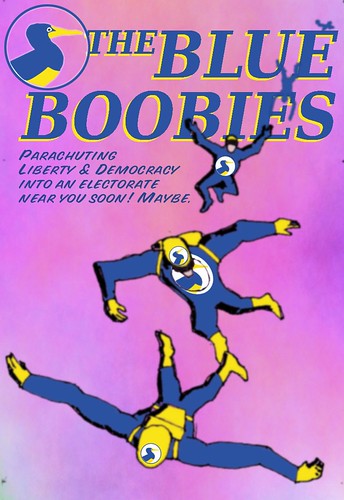
BB-800x1162

"Parachuting" - it's what members of local branches of the major parties bitch about when they find themselves saddled with a candidate who they've never met. Someone whose last job was as a staffer to a party big-wig. But minor parties do it too.

A quick check of the House of Reps candidates list (downloaded from the Australian Electoral Commission web-site), turned up no fewer than 19 minor party parachutists - 15 of them from the LDP. Victoria scores 5 of those, all with contact addresses in Queensland.

The other 4 parachutists? One Independent and one candidate each from the Australian Democrats, the Christian Democratic Party (Fred Nile Group) and the Socialist Equity Party. No, never heard of that last lot before either.

(Cross-posted at Larvatus Prodeo in Exile)

Thursday, October 25, 2007

Just Out


New Model: PGK-QE-KW1, "Windy".
Note: This model supercedes model PGK-QE-PPMcG1, which has been discontinued.

(Hat tip to The Unknown Googler)

Monday, October 22, 2007

A Dried Out Leaf (V)

Seam Carving

This morning's drawing exercise was another one of those "expand your comfort zone" exercises. The result was a drawing of yet another leaf (a different one this time - I'm considering the possibility of embedding the last leaf in epoxy resin, to make a cute little paperweight for sale with the ink drawing of it that's already on offer. If only I had the skills, and the time, to craft a matching set of steak knives). This morning's drawing is on Conte crayon on cartridge paper, initialled and dated by yours truly and definitely not for sale. It has a crap half and a not so crap half.

So let's file that one away in the manila folder of "Drawings - Exercise" for now and take a look at that noxious little genie I mentioned in the first post in this series - his name is "seam carving". You can check him out in this YouTube clip. What seam-carving promises is "content-aware image resizing". I find the results a bit of an eyesore.

(Note: although the link points to a video plugging commercial software for seam-carving, there are open-source packages out there as well).

Seam-carving is a way of taking "unimportant" detail - typically background detail - out of an image as it is resized, without altering the "content". That is whatever a web-page designer decided is important in the picture. It's a "solution" to the "problem" that arises when a computer user resizes a browser window and the the text adjusts to the new window dimensions, but the images just sit there, obstinately refusing to shift from their current 500x375 pixel resolution.

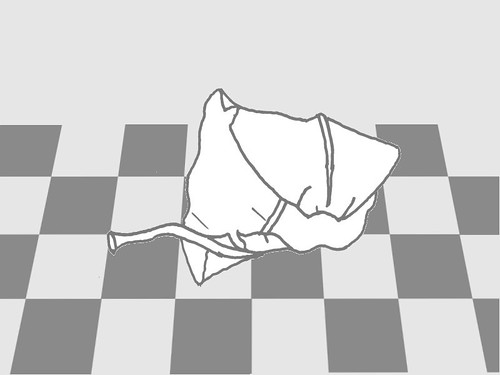
Here's that leaf again (the hilariously over-priced one), in a new visual context that I'll be using to illustrate what happens to an image when it's seam-carved for resizing. In this image the leaf is placed at the centre, on what appears (thanks to the perspective of the chequerboard) to be a flat, horizontal surface. Behind it, I've implied a vertical surface, or just open space.

seam-carve-01

Let's set some conditions for how the image is to be resized, if it is stretched in any direction - horizontally, vertically or a combination of both. They are:

The leaf is to remain at the visual centre of the image;
It is to stay the same size throughout the transformation.

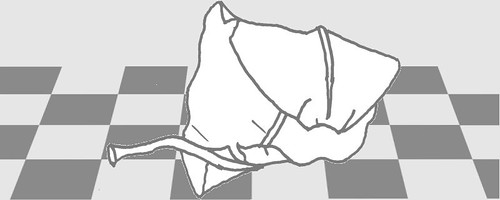
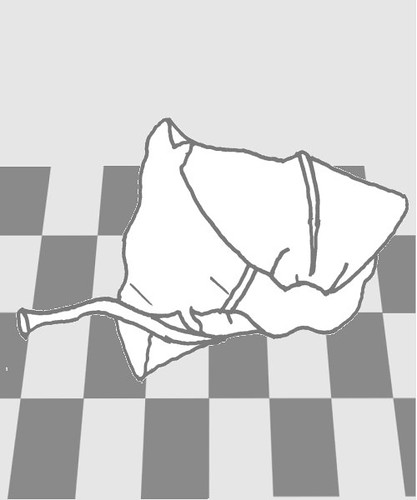
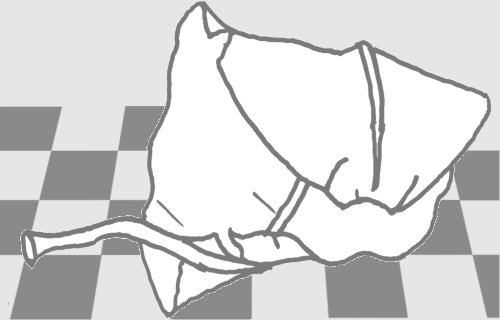
Now let's look at what happens, under those conditions, when we reduce first the height of the image, then its width, then reduce both to smallest size we are prepared to accept.

seam-carve-02
Minimum Image Height

seam-carve-03
Minimum Image Width

seam-carve-04Minimimum Image Area

I hope it's obvious from examining and comparing these three images that the alterations to the background we've made to keep the leaf centred at the same size have altered our perception of the leaf - particularly in the last image, where the leaf appears to have grown a lot larger. To watch the process happening dynamically (in the YouTube video) is, for me, quite unsettling and a little fatiguing.

I'll leave this topic here for now and come back to it either in a new post or an update. Now that I've hit the topic of "seam-carving" we're starting to get to the meat of this series.

Saturday, October 20, 2007

A Dried Out Leaf (IV)

(With Defi)

First up, here's a little affront to your visual perception:


There's not much to say about the production of that one - I GIMPed it out quickly this morning, as a sop to the left side of my brain - the half that went into a screaming hissy-fit yesterday morning because "I can't do that stuff and it's not fair - you're giving all your time to right half ..." etc, etc, etc. That moment was a long time coming but it was inevitable - I shouldn't have been so dismissive of the frequent remarks in the teach yourself drawing book that sometimes the process would be emotionally disturbing. One thing I'm sure of, after yesterday's experience - at $100 (or 100 francs) a two minute drawing by Picasso was dirt cheap.

There is quite a bit to say about what the image does to your visual perceptions - and how that's achieved - but I'm setting that aside for later. There's at least one more illustration to produce first. For now I'll content myself with stating, quite emphatically, that the one thing the image is not is an optical illusion. Quite the reverse - it combines three standard techniques for producing the impression of depth in a two dimensional image to produce a result that is quite simply, irreconcilable as a whole image. You'll see what I mean if you sit and look at it and let it jangle your brain for a bit. Don't spent too long - it's very discordant and might upset you. Seriously. It's complete visual nonsense, so there's no point working yourself into a tizzy trying to make sense of it.

Today's teach yourself drawing exercise is to flog off the original drawing for the princely sum of $200 (AU). I have several good reasons for doing this. At the more respectable end of the list - the justification and rationalisation end - getting rid of the original is a good way to detach from it (it's only a piece of paper with ink and pencil markings on it), so I can concentrate on its uses - partly play, and partly to illustrate and drive home the occasional point about visual perception and the veracity, authority or integrity of images. Not as a souvenir of a fraught day where I got far too upset over the fact that I'd just botched a drawing of a leaf, then came home after a visit to my one and only friendly ex-wife (as in, I only have one ex-wife, we're still friendly, and she's a very unique individual) to knock off the drawing in a few minutes.

Why $200? Well, it's a nice round figure but it comprises 3 components - eight hours work at or around the minimum wage ($132.00), Workcover compensation for the self-inflicted emotional trauma and, finally, postage and handling (all up, the other $70). What you get - in the unlikely event that you take up the offer, is an A4 sheet of graphic artist's tracing paper, with the drawing rendered in ink and pencil. And that's it, so we'll move on to the less respectable end of my list of reasons - sheer emotional and financial desparation, of which I've had a gutful.

Buy the Drawing


I'm quite sure at this stage, that I've delivered a second affront to a few readers - those of you who're scrolling down the post to hit the comments link so that you can denounce this as nothing more than on-line begging - a blatant bleg. Don't waste your time - comments is gone. You might, however, be interested in the alternative, which I'll describe later.

Defi

Begging my arse. It's an open, and honest free market transaction. The merchandise, as described, exists. It will be despatched to the first purchaser to stump up the $200 through that PayPal button that's been sitting idle over on the left-hand side of the page. If anybody does buy the drawing, I'm not interested in their motivations for doing so. I don't expect them to be to interested, respectful, or sympathetic to my motivations for selling. You want the drawing - it's yours, for $200, take it or leave it. You'll get more for your money than Helga got for the $4000 she spent ordering a Hewlett-Packard computer, from a "reputable" major retailer (the story's probably hit the business news by now, but I haven't been tracking it). The day after she ordered the computer, the company went into receivership. As an unsecured creditor, the most she can realistically expect out of the transaction is a dividend of 10 cents in the dollar - $3600 down the tubes in 24 hours. That's reputable Australian business practice.

Still got some abuse to vent? Well, here's the deal - the replacement for the comments facility I mentioned earlier. Use the "Flame Gummo" button - for a mere $5.00 donation via PayPal, you can vent your spleen, your gall bladder and your flatus-bloated bowels in an e-mail to me. I'm not kidding.

Flame Gummo


Now that's really affronted you, hasn't it? I can hear the huffing and puffing already - what have we come to, when someone is prepared to cop online abuse for $5.00 a throw. What sort of debased individual would demean himself that way?

Still not prepared to part with your money? Well, that leaves two last options.

If you're really so sickened by this post as you profess, put your vote where your mouth is. It won't cost you a cent. In the coming election, cast your vote so that it ends up - via whatever circuitous perambulation through our system of preference allocation suits you - so that it ends up with the ALP.

I'm not entirely rapt with Kevin Rudd either, but I'll still be casting my vote for the ALP. Because I want to live in a civil society again - I'm bloody desperate to live in a civil society again. Because I'm sick of the Liberal Party's Theatre of Cruelty - the ongoing soap opera of Work for the Dole (with the new spin off show, Welfare to Work) the big spectacles like Tampa and the Northern Territory intervention, the little kitchen-sink dramas like Federal Police raids on the homes of Australian Muslims that turn up nothing, the trashing of Mamdouh Habib's reputation, the Haneef Affair. This is a government that has repeatedly, and routinely, victimised private citizens for no better purpose than to give all you nice people out there someone you can despise.

As Ziggy Stellenstaub, my head-care specialist, said at our last get-together, if the Liberal Party win this one, they'll believe they can get away with anything. As someone who can confidently expect to be on the debasing and demeaning end of whatever "anything" succeeds Welfare to Work, whose next change of residence if something isn't done about providing affordable rental accomodation is going to be from an almost, but not quite affordable suburban house to the street, with all the asset losses that entails, I've got a very strong vested interest in seeing that "anything" forestalled.

Don't think much of that option either? Well, you can always don the mantle of sanctimonious hypocrite and denounce me in whatever public forum - be it a blog or a newspaper column - you can use. Just don't come around here expecting to kick Trotsky unless you're prepared to pay for the privilege. Your bigotted, "one-dream-fits-all and if it doesn't we'll bloody well make you fit it", idea of what this country should be doesn't interest me. It never really did.

Friday, October 19, 2007

A Dried Out Leaf (III)


Nailed the twisted little sucker! Now maybe I can move onto some more interesting stuff (in both the drawing, and the writing).

Harry Nails It.

It being his own metatarsus:
Howard closes in on the riff-raff.
Everything that's wrong with, and wrong about, conservative commentary on this election and the conservative attitude generally in just seven words.

There's more too, but nothing that you couldn't find elsewhere, no less ill-considered, and no less shitty-livered.

Thanks for the "Cheerful Friday thought" Harry - it's brightened my day up a lot. Which it needed.

A Dried Out Leaf (II)

I recently heard, or read, an amusing little anecdote about Picasso. I've forgotten where.

Picasso was asked - no doubt by somebody equally famous - for a drawing. He took a table napkin, drew on it for a couple of minutes, handed the napkin over and asked for a hundred dollars. Or francs maybe.

"A hundred dollars for that? But it only took you two minutes to draw!" was the aghast response.

"Plus fifty years of learning how to do it."

Today's teach myself how to draw exercise was to render the pencil sketch of the leaf in ink. It didn't work out very well as you'll see from the scan of the result: 13 pen strokes on a carefully drawn grid before I decided that I'd botched the job and gave up.

The exercise wasn't an attempt to outdo Picasso: my aim was to attack a problem that's stuffed up other drawings I've produced: the problem of hand tremor. You can see the effect of hand tremor in the image below, a detail of a panel from a new comic strip I've started working on. And stopped again, for this week at least.


Despite a generous application of blurring (using the GIMP's Gaussian blur feature) the lines of the Parliament House flag-pole are noticeably wobbly. That's because they were traced slowly, giving the Trotsky nervous system too much time to fret about the fact that I was working with real, indelible ink on an expensive piece of quality tracing paper (well, more expensive than the crap, picked it up cheap at the newsagent, paper I usually use for drawings that are going to end up digitised).

Three simple mistakes killed today's drawing.

First up, I left the diagonal in the 6x6 grid of rectangles I drew as a guide for the copying. The diagonal was only there as a guide in the grid construction. But, because I neglected to erase it, as soon as I started drawing strokes that crossed it, it became attractive as an additional guide. The inevitable result - confusion, and misplaced strokes.

Second, I bottled out. Instead of pushing through that "OMG I'm actually going to use 110 gsm cartridge this time" barrier, I went the cheap crappy paper option.

I've forgotten the third. Whatever it was, it seems to have been fixed by taping the pencil drawing on a clean kitchen chopping board, and then over that a sheet of that tracing paper, so that I can work on a firm surface that I can tilt to any angle. That's a gunna do solution until I've got budget for a drawing board.

And with those mistakes identified and out of the way, what did I get right?

Well, first up, taking it slowly, visualising each stroke - even practising it in the air above the paper - before actually touching pen to paper worked well. That technique is a keeper.

Bizarre as it sounds, consciously putting white space between strokes works better - at this stage at least - than trying to connect them. The aim was to get used to drawing ink strokes quickly and cleanly - worrying about whether they connect just gets in the way.

Third, I stopped when as soon as it became obvious that it wasn't working. I'll tackle the job again later, under better conditions. There's a whole can of worms hidden in the previous sentence but I'm not going to open it today. Let's just say that some days, and for some purposes, it makes a lot more sense not to get back on the bicycle straight away. You need to take a little time to rub your sore bum first.

Thursday, October 18, 2007

A Dried Out Leaf


Partly it's the season and partly it's the prospect that the Howard years really are ending on November the 24th that has me in a good mood today. The seasonal part is that whole
Whan that Aprill with his shoures soote
The droghte of March hath perced to the roote,
And bathed every veyn in swich licour
Of which virtu engendered is the flour;
thing. I don't think my attitude to the election needs much explanation - once again, we've been given the chance to get rid of Australia's worst Prime Minister this century - probably the worst since Federation, for the meiosis challenged - and this time it looks like the electorate is finally going to take the opportunity.

There's one other major contributor to my good mood - I've found a new skill to learn. This time it's drawing. Looking back now, I realise that I was doomed to start teaching myself - or re-teaching myself - how to draw from the very first time I used The GIMP to doctor a photograph. Another major steps along the road to this new perdition was producing that first picture of The Indefatigable Wingnut (Episode 6 currently in production).

So now, every day starts with me running up the blinds in my study/den/home office and sitting down at the desk for a drawimg warm up. Today's warm up was drawing a dried out leaf I found in the back yard - the one in the picture (my HP OfficeJet LX lost a lot of the pencilled shading, so I've colorised it to bring out some of the contrast that was lost).

Drawing the leaf was a two stage process (just in case anyone's thinking of trying it at home). The first stage was to draw the leaf with the desk set up so that I couldn't see the drawing paper (a portable file holder works quite well for this if you're using A4 paper). The second was to draw it with the paper visible, but with my attention on the leaf, not the drawing. The only times I look at the drawing are when I've lost my way a bit, and need to reposition the pencil.

One interesting side effect of this new avocation is that I'm looking at the world around me with a new set of interests. A similar thing happened in my shutterbugging days - I would spend a lot of time thinking about how ordinary everyday scenes would look through a camera viewfinder and a lot more alert to the part light and shade play in our visual perception of our everyday world.

A second interesting side effect is that when I'm writing things in my head, they're more likely to be about the imaged world - the world as depicted in photographs, drawings and paintings - and how that imaged world can be manipulated. One form of digital image manipulation I serendipitously discovered yesterday gives me the willies - it's a dangerous little genie indeed and one day I'd like to thoroughly anethematise the idiots who decided to open its bottle.

But not today. I'd rather sit and look at the original drawing behind that scan and mentally rehearse the process of converting it to a line drawing in ink. I reckon the first stage will be to copy it with a 2H pencil to reduce it to a set of pen strokes that can be produced quickly and smoothly, with neither hand tremor or smudging from supporting the pen on the paper. Then a couple of rehearsals on scrap paper before I tackle it on 110 gsm cartridge.

To finish, I'll just throw out a couple of quick remarks that would otherwise nag at me, demanding to be written about, so that I can keep my head clear for what's important to me right now.

First, at the end of the nineteenth century, the French Third Republic was riven by The Dreyfus Affair. it divided the nation into two bitterly opposed factions - Dreyfussards and anti-Dreyfussards. According to the Wikipedia article cited (which prima facie is not to be trusted):
... The right-wing Vichy Regime was composed to some extent of old anti-Dreyfusards and their descendants. The Vichy Regime would later deport Dreyfus' grand-daughter to her death at Nazi extermination camps.
Any historians out there looking for a topic for a blog post? A quick compare and contrast might while away an otherwise boring afternoon.

I'll conclude this not so quick remark by noting that since the turn of the century this government has managed to produce quite a few scandals of its own: the Tampa incident, the Habib case, the cases of Cornelia Rau and Vivian Solon, the Haneef Affair and Kevin Andrew's stupid remarks on Sudanese immigrants. Any would-be Zolas out there? Hello?

That wasn't so quick, really, was it? Let's see if I can get number two out of the way with a little more dispatch.

It's pretty bloody ludicrous when a soi-dissant iconoclast derides an artist for producing works with obvious iconoclastic intent as his (said blogger's) Lameass of the Month. Still, the blog's name is apt.

Yep, that did it. Just the right balance of pith and vinegar.

Wednesday, October 03, 2007

Monday, October 01, 2007

A Week with Wingnut


Monday Morning: Some diarist, eh? Two days into this silly venture and I've already missed a day.

So, what happened yesterday? Nothing much. A bit more sketching and scanning, ant then a lot of time out in the afternoon to put together a picture of the giant helium balloon I expect the ALP to enter in this year's inaugural Sydney Christmas (and not Thanksgiving) Parade. If the reports that the election will be Saturday November 24th are right and the polls hold up, it might turn out to be a thanksgiving parade anyway.

Saturday, September 29, 2007

My Week with Wingnut

Saturday Morning: Check comments at Larvatus Prodeo and learn that "Doink!" - the sound of a wingerang bouncing off Wingnut's head - was once used by Mad Magazine's Don Martin. Oops! What the hell - I'll go ahead with the next episode, more or less as I planned it on Thursday, taking up a suggestion of Zeppo Bakunin's. Time to start drawing up the storyboard.

Instead of starting on the storyboard, I make the mistake of checking out some of the latest links to LP and discover a blog post by a strident fallacist on LP's most recent Flying Monkey incident. Like any fallacist argument, the post is riddled with fallacious reasoning - according to the post author's own taxonomy of fallacies, it's a pretty good example of browbeating. The taxonomy itself proves to be unreliable - it includes, for example, "Moral Equivalence" with this definition:
The advocate seeks to draw false moral comparisons between two phenomena which are not morally equivalent.
Ethics 101: ethics isn't about phenomena but human actions, choices and decisions. If for example, you want to argue that it's wrong to kill Tom, Dick or Harry but OK to kill Ahmed, you have to mount a pretty good case to show that Ahmed is so very different from Tom, Dick and Harry as to justify your position.

I put off the storyboard work to knock out a quick drawing of an arse-clown:


There, that's one distraction out of the way.

Postscript: no Theo, you don't have my permission to use the picture of the arse-clown in future.

Wednesday, September 19, 2007

Word of the Day - Salinisation

The process whereby soluble salts accumulate within the soil.

That's just one of several definitions of the word I found with a simple Google search. Surprising really because, according to one well-known authority, the word either doesn't exist or it should be spelt salinization - I'm not sure which:

So, we could smile to read contestant Snezana declare that "Salinisation (sic) of land is one of the major environemtal (sic) crises facing Australia", and Kirra warn that "the biggest problem in our enviroment (sic) today is our lack of water".

At worst we'd have wondered how badly we teach English as Angelique demanded help for an "environmnet" in danger, and Natalia wept for an "enviornment (sic) that sustains us". (Andrew Bolt in The Hun)


And you might wonder whether it's really so much worse than when young Andrew was at school and somehow omitted to learn that salinisation is both a bona fide word in English and, in Australian usage, spelt pretty much as it appears in Snezana's declaration. At least, I think that's the case.

But I could be wrong about that - if so, I'm not the only one. All these people seem to be labouring under the same misapprehension. Someone ought to write to them and tell them, don't you think?

Tuesday, September 18, 2007

Another Fine Moment From Mr 38 Percent

Gary Ramage of The Australian* took the original photo - I doctored it a bit. I doubt that this little gesture from John Howard to his opposite number is going to go over too well with the 48% of voters who prefer Rudd as Prime Minister. It might swing a few of the 14% of voters who are undecided against Howard too. Sometimes it's surprisingly painful what a momentary lapse into infantile self-indulgence will cost you.

(via The Ostrahyun)

Monday, September 17, 2007

Oops!

Posting's been a little light on around here recently, hasn't it? That's because - partly thanks to some misguided encouragement in the comments on this post - I got sucked into mucking around with computer graphics big time. If you haven't checked them out already, you can see the results here, here, and here.

There's a fourth episode of The Indefatigable Wingnut in production - the first three frames of the comic have passed the Zeppo Bakunin chuckle test with flying colours but, nonetheless, I find myself in a bit of an embarassing bind.

All the action takes place in a so far nameless city - which might not be such a big problem. But not having a name for the arch villain of the piece is starting to bug me. Here's what he looks like:


Any suggestions?

Saturday, September 08, 2007

Thursday, August 23, 2007

Rasputin Sighted Again!

Rasputin at a recent meeting with the Australian which never actually occurred and even if it did occur nothing much was discussed and the Prime Minister meets with lots of people, so there's nothing special in him meeting Rasputin, assuming that he did, which of course, he didn't.

Not a Photoshop

And nobody's claiming that it's art, either.

Still Life with Fugitive Banana

(Image produced with the GIMP).

Friday, August 17, 2007

Friday, August 10, 2007

By Request


A US Percy class nuclear submarine during an emergency surfacing drill. The distinctive bulge of the boat's Global Location And Navigation System is clearly visible at the bow.

Thursday, August 09, 2007

Friday Dog-Blogging

Lesser Known Dog Breeds

Serengeti Giraffe Hound

Like its distant cousins, the greyhound, the pharaoh hound and the ibizan hound, the Serengeti Giraffe Hound is a gaze hound, bred for the sport coursing small game. The breed was established by the Rev James Huffington, an Anglican missionary to Africa in the mid nineteenth century and keen follower of the sport of coursing (he was, in his university days, a devoted beagler).

The Giraffe Hound's intended prey were marmosets, lemurs, and other arboreal creatures in cautious enough to descend to ground level. According to Huffington (whose testimony is generally considered unreliable) his dogs eventually excelled in the sport of hunting down and retrieving such game. To what end is not clear. Others are more skeptical of the breed's suitability for any purpose.

The Giraffe Hound is strictly an outdoor dog, and therefore unsuitable for anyone living in a flat or small unit. Despite the breed's appalling reputation for health problems - chiefly hip dysplasia and hypertension - it nonetheless enjoys some favour with those who hate cats and possums.

The Micro-Miniature Poodle (Nanoodle)

This controversial, recently recognised, breed has replaced the chihuahua as the smallest of the dog breeds. At less than 1mm in length from head to anus the Micro-Miniature Poodle (or Nanoodle) is barely visible to the naked eye.

The illustration is a scanning electron micrograph of a nanoodle sitting on a wooden porch.

Saturday, August 04, 2007

New from TBP

Features:

  • Special Rapid Application & Quick Drying Formulation!
  • Sun-Proof and Weatherproof!
  • Long Lasting Fly Repellant and Anti-Bacterial action!
  • TBP's exclusive Odor-Gard deodorant action!

Friday, August 03, 2007

Friday Dog-Blogging

Another great moment from the career of Gympie Flyer,
Australian Racing Legend.

Albion Park, 1983 - despite a leg injury Gympie Flyer held the lead right from the start and finished first.

Thursday, August 02, 2007

Believe It or Not

It must be a slow news day. According to the front page of today's Age, a man claiming membership of a non-existent group of disadvantaged Australians was awarded $525,000 compensation for events that couldn't possibly have happened but even if they did happen it was all intended for his own good and it's only by today's standards that anybody did anything wrong so any alleged harm he might have suffered was completely unintentional.

(Cross-posted at Larvatus Prodeo)

The Very Proper Gander

(A timely tale for a nation of hysterics)

Not so long ago there was a very fine gander. He was strong and smooth and beautiful and he spent most of his time singing to his wife and children. One day somebody who saw him strutting up and down in his yard and singing remarked , 'There is a very proper gander.' An old hen overheard this and told her husband about it that night in the roost. 'They said something about propaganda' she said. 'I have always suspected that' said the rooster, and he went around the barnyard next day telling everybody that the very fine gander was a dangerous bird, more than likely a hawk in gander's clothing. A small brown hen remembered a time when at a great distance she had seen the gander talking with some hawks in the forest. 'They were up to no good' she said. A duck remembered that the gander once told him that he did not believe in anything. 'He said to hell with the flag, too,' said the duck. A guinea hen recalled that she had once seen somebody who looked very much like the gander throw something that loked a great deal like a bomb. Finally, everybody snatched up sticks and stones and descended on the gander's house. He was strutting in his front yard, singing to his children and wife. 'There he is!' everybody cried. 'Hawk-lover! Unbeliever! Flag-hater! Bomb-thrower!' So they set upon him and drove him out of the country.

Moral: Anybody who you or your wife thinks is going to overthrow the government by violence must be driven out of the country.

James Thurber, Fables for Our Time and Illustrated Poems.

And to hell with the flag, too.

Sunday, July 29, 2007

Word of the Day - Hubris


The picture says it all, really.

Saturday, July 28, 2007

Saturday Dog-Blogging

Celebrating Gympie Flyer, an Australian Racing Legend.

A dog with more heart than Phar Lap.


Southport 1982 - Gympie Flyer coming home at full pelt.

Monday, July 23, 2007

Giving 'Em the Wrong End of the Stick

Nothing sets the blogosphere on fire like a good rant - like this splendid example of the genre from pommygranate.

Moved by recent events in Burnley, Lancs*, where Matthew Carter, a binman, has been forbidden to wear a St George Cross over his dreadlocks, pommygranate takes the angry stick to anyone who might approve of the ban:

I despise you for dreaming up and enforcing rules such as these. Rules that make people shake with anger and seek solace in the arms of truly unsavoury folk.

I despise you for making this man feel guilty about taking pride in his own country.
(original emphasis)
The rant's being quoted, and linked, by such luminaries of the right as Bernard Slattery, who says:
This letter should be so widely read that whole floors of federal, state and local government offices are squirming with terminal embarrassment.
Rolling on the floor laughing their arses off is more likely, unless there's actually a secret Federal State or even local council Department of the Old Dart somewhere, that's actually been running the UK for years. A hidden politically correct leftist enclave of the bureaucracy, paying back the Mother Country for Gallipoli, Singapore and other assorted past wrongs, by making life for the English as silly as possible. And there's poor old Gordon Brown thinking he's running the country.

Elsewhere Harry Clarke's giving good rant on the Haneef farce:
The press and the infantile, leftwing blogosphere are having a field day making conjectures that foster views of the innocence or guilt of Mohammed Haneef...

Australia is fast becoming a nation of hysterics who rant over perceived injustices and perceived moves toward totalitarianism even when faced with a possible investigation of a threat of terrorism to our citizens. To the know-all peanuts who pursue this line: Let the AFP and the courts do their job. Have a non-adolescent level of patience and keep a sense of proportion.

Denigrating the AFP, indulging in conspiracy theories and, most importantly, trivialising the pursuit of terrorist saboteurs in Western democracies is irresponsible behaviour. (original emphasis)
Well, I have to agree with Harry on that first point - maybe we are becoming a nation of hysterics. The evidence of pommygranate's post and Harry's post certainly support that view. Read them and you might find yourself in hysterics too.

* - an English town not far from Manchester but the best part of 13,000 miles from Melbourne, Sydney, Canberra or any of Australia's provincial cities - such as Perth.

Movie Classics

A still from the long forgotten Australian silent film The Cabinet of John Winston Howard.

Saturday, July 21, 2007

Wednesday, July 18, 2007

Haneef admits it: "I was arrested"

Q38. Do you recall me saying that. That you were under arrest.

A. Yes you arrested me um, but I didn't know that, ah then you, you said that I have been ah involved in terrorist activities. But I deny that I have been involved in any...

Q39. Okay. Do you agree that I told you at that time that you were under arrest for providing material support to terrorist organisation.

A. Well I haven't, I, I haven't provided...

Q40. Okay. I understand that but I'm saying to you, do you agree that that's what I said to you.

A. Well I, I've submitted to you for whatever reasons, you have ah taken um top clear myself from whatever charges I am being put on.

Q41. Okay. I'm just asking you whether, do you recall me saying that you were under arrest.

A. Yes.

More here (PDF).

Phil Ruddock is spitting chips that this damning admission was leaked to The Oz.

Egging Brendan

Defence Minister Brendan Nelson, might find himself with a few things to explain about his handling of the Education portfolio, back in the day:
THE long-held secret of which nine Australian Research Council grants were vetoed by former education minister Brendan Nelson may soon be out, with the affected researchers to be asked whether they want the details made public.

...

Dr Nelson vetoed three projects in 2004 and seven in 2005 (one of which had been rejected in 2004, suggesting there were nine academics involved). These Discovery projects - believed to be in the social sciences and humanities - had been approved by ARC peer review.
(National Rupert Daily)
Any embarassment that might cause our Brendan, will come on top of being made a liar by Kevin Andrews' decision that Doctor Muhammed Haneef - reckless supplier of mobile phone facilities to family members who later turned out to be terrorists - will go into immigration detention if he ever takes advantage of his grant of bail. Last Thursday, The Times of India reported:
Refusing to go into merits or otherwise of the case of Haneef, who has been detained for the last nine days, or divulge details of the investigation, Nelson said there was "no intention to detain him (Haneef) beyond a period that is considered by the judge as appropriate."
The report, ironically, is headlined "Haneef case: India promises Australia all help". Pity it looks as if the promise was obtained under false pretences, making it completely void. But what do integrity and good diplomatic relations matter when you've got an election to win.

(Cross Posted at Larvatus Prodeo)